How to Choose ESE Coaching – 5 Things to Check Before You Join
Choosing an ESE coaching programme is a 12-month commitment of time, money, and energy. With the UPSC Engineering Services Examination selecting approximately 167 engineers from 1.5 lakh registrations every year, how you prepare matters as much as how hard you prepare.
Most engineering students in Chennai begin evaluating coaching options at one of two points: right after final-year results, or after an unsuccessful first attempt. Both groups tend to ask the same question — what should I actually be looking for in an ESE coaching programme?
This guide gives you five specific things to check before you join any ESE coaching centre in Chennai — not generic advice, but concrete criteria that separate a programme that will prepare you for the full exam from one that covers only the easy parts.
New to ESE? Start with our Complete ESE / IES Guide for 2027 first, then come back here.
What this guide covers:
- ESE self-study vs coaching — where the real gap is
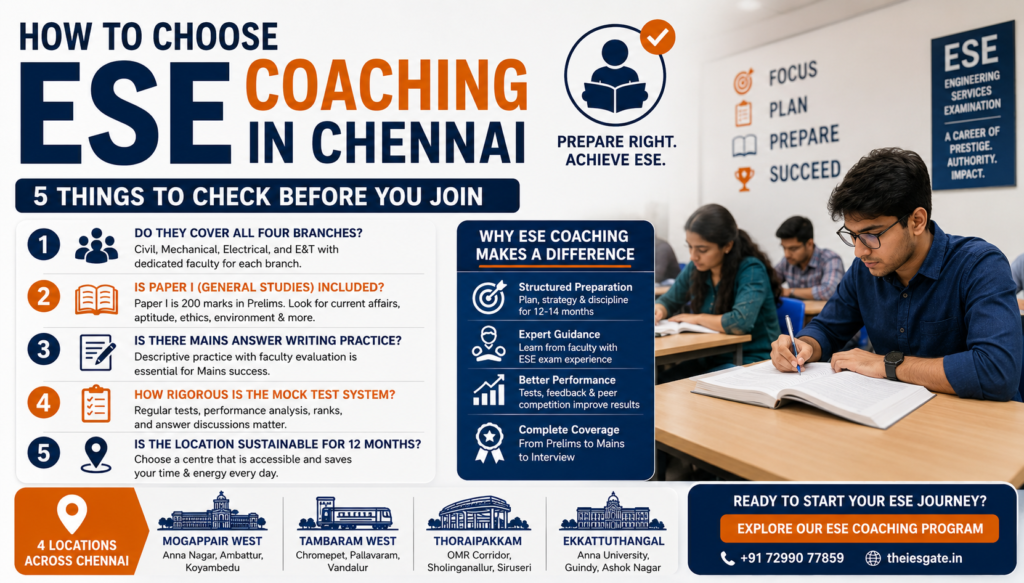
- Check 1: Do they cover all four ESE branches?
- Check 2: Is Paper I (General Studies) part of the programme?
- Check 3: Do they have structured Mains answer writing?
- Check 4: How rigorous is the mock test system?
- Check 5: Is the location sustainable for 12 months?
- Should you join combined ESE + GATE coaching?
- ESE coaching locations in Chennai
ESE Self-Study vs Coaching — Where the Real Gap Is
Self-study for ESE is not impossible. Some candidates clear ESE without coaching — typically engineers with 3–5 years of job experience, strong conceptual foundations from college, and the discipline to maintain a 10-hour daily schedule for 14 months without external structure.
For most students — especially those preparing immediately after graduation — the gap shows up in three specific areas that self-study handles poorly:
The Mains descriptive format
The ESE Mains requires written answers — full derivations, labelled diagrams, justified assumptions, structured solutions — in a 3-hour exam. Writing a correct answer is different from presenting a correct answer in the format a UPSC examiner expects. This skill requires evaluated feedback on actual written answers, not just marking yourself against an answer key. Coaching provides this; self-study does not.
Paper I has no textbook
The General Studies and Engineering Aptitude paper (Paper I, 200 marks in Prelims) covers current affairs, engineering ethics, project management basics, environmental and energy topics, ICT fundamentals — a mix with no single reference source. Many candidates who do well on the technical paper lose the Prelims cutoff because their Paper I score is 40–50 marks below what a structured preparation would have delivered. A coaching programme provides curated notes, a monthly current affairs system, and tested practice papers for this.
No performance benchmark
Without a peer group and a structured test system, you have no way to know where you stand relative to the actual competition until it is too late to adjust. Batch-level mock tests and subject-wise rankings within a coaching programme give you this signal in time to change strategy.
If you have decided coaching is the right path, here is what to specifically check before joining.
Check 1 — Does the Centre Cover All Four ESE Branches?
ESE is conducted for four engineering disciplines only: Civil Engineering, Mechanical Engineering, Electrical Engineering, and Electronics and Telecommunication Engineering. If a coaching centre covers only one or two of these — or if they teach CE and ME well but outsource the EE and E&T classes — the depth of instruction across branches will be uneven.
Why this matters: the ESE technical paper tests the full depth of your engineering discipline, not just the high-weightage topics. A centre with strong faculty across all four branches can provide peer learning — CE and ME students sitting in the same test sessions, competing for Prelims rank within the batch. This cross-discipline competition raises preparation standards.
What to ask: How many faculty members teach each branch? Are they branch-specific or do the same 2–3 people cover everything? Can you sit in on a class for your branch before joining?
At IES GATE Training Academy, all four ESE-eligible branches are taught by discipline-specific faculty across all four Chennai branches — Mogappair, Tambaram, Thoraipakkam, and Ekkattuthangal. Find out more about our ESE coaching programme here.
Check 2 — Is Paper I (General Studies) Included in the Programme?
This is the most important differentiator between an ESE-specific coaching programme and a GATE coaching programme that has been relabelled for ESE.
GATE does not have a General Studies component. ESE does — and it carries 200 of the 500 Prelims marks. A programme that only teaches the technical paper is preparing you for 60% of the Prelims, not 100%.
Paper I topics include:
- Current issues of national and international importance
- Engineering Aptitude — Logical Reasoning and Analytical Ability
- Engineering Mathematics and Numerical Analysis
- Standards, Quality, and Safety in Production and Construction
- Energy and Environment — conservation, pollution, climate basics
- Project Management fundamentals (CPM/PERT, contracts, estimation)
- Ethics and Values in the Engineering Profession
- ICT basics — hardware, software, networks
A quality ESE programme includes dedicated Paper I classes, monthly current affairs digests, and at least 6–8 full Paper I mock tests across the preparation cycle — not a 2-week crash course two months before the Prelims.
What to ask: How many hours per week are scheduled for Paper I? Is current affairs covered systematically or left to the student? Are Paper I and Paper II mock tests conducted together (as in the actual exam) or separately?
For a detailed breakdown of the Paper I syllabus, see our ESE Syllabus and Preparation Strategy guide.
Check 3 — Is There Structured Mains Descriptive Practice?
The ESE Mains is a conventional (pen and paper, descriptive) exam. Two papers, 300 marks each, 3 hours each. You write full derivations, draw labelled diagrams, solve multi-step applied problems, and structure answers in a way that communicates both the method and the reasoning.
This is a completely different skill from attempting objective questions. A student who scores 85% on Prelims mock tests can still perform poorly in the Mains if they have never practiced the descriptive format under time pressure with evaluated feedback.
A coaching programme that is serious about ESE Mains preparation should include:
- Dedicated answer writing sessions — students write full Mains-style answers, not just bullet points
- Faculty evaluation of written answers with feedback on structure, diagram quality, and presentation
- Previous year Mains question analysis — ESE Mains 2010 to 2026 — as practice material
- At least 4–6 full Mains mock papers under timed conditions before the actual exam
What to ask: When does Mains answer writing practice start in the programme — Month 1 or Month 8? Who evaluates the answers? Can you see a sample evaluated answer sheet from a previous batch?
At IES GATE Training Academy, Mains descriptive practice begins from Phase 2 (Month 6 onwards) and continues alongside Prelims mock testing through Phase 3. See what our ESE programme covers.
Check 4 — How Rigorous Is the Mock Test System?
Mock tests are not just practice — they are the primary diagnostic tool for identifying where preparation is weak. A rigorous mock test system provides three things: realistic exam simulation, performance data by subject, and a competitive rank within the batch.
For ESE, a complete mock test system should include:
- Subject-wise tests after each topic — not just at the end of the programme
- Full-length Prelims mock tests (Paper I + Paper II together, back to back) — at least 8–10 across the year
- Previous year Prelims papers as timed tests — not just for reading
- Negative marking simulation in all Prelims tests (1/3 penalty as in the actual exam)
- Rank within the batch after each full mock — tells you where you stand relative to peers
- Answer analysis sessions after each test — not just the answer key, but the reasoning for wrong answers
What to ask: How many full-length Prelims mock tests are scheduled? Is Paper I tested separately or alongside Paper II as in the actual exam? Are ranks published within the batch after each test?
Check 5 — Is the Location Sustainable for 12 Months?
ESE preparation is a 12–14 month process. A coaching centre that takes 90 minutes each way to reach will cost you 3 hours of commute daily — 900+ hours across the preparation cycle. That is a significant preparation time loss, and fatigue from long commutes compounds across months.
Chennai’s traffic makes location a real preparation variable, not a convenience preference. A student in Tambaram attending a centre in Anna Nagar is making a different trade-off than one at a branch in Tambaram itself.
Students from different parts of Chennai — and the engineering colleges they come from — tend to cluster around coaching centres by location:
- Anna Nagar, Ambattur, Kolathur, Padi area: The Mogappair West branch serves north and north-west Chennai. Students from Ambattur Industrial area, Koyambedu, and the CMBT corridor attend this branch.
- Tambaram, Chromepet, Pallavaram, Vandalur: The Tambaram West branch — near BSNL Telephone Exchange — serves the south-west corridor. Students from Southern Railway township, Pallavaram, and Vandalur regularly attend.
- Sholinganallur, Perungudi, Pallikaranai, Siruseri, Kelambakkam: The Thoraipakkam branch on the OMR corridor serves the entire IT and engineering college belt from Perungudi to Kelambakkam. Students from SRM Kattankulathur, Rajalakshmi, and Saveetha find this branch the most accessible.
- Guindy, Ashok Nagar, K.K. Nagar, Saidapet, Vadapalani: The Ekkattuthangal branch is the most central-south location — 15–20 minutes from Anna University / College of Engineering Guindy. Students targeting CPWD postings from the CEG Civil Engineering department find this branch most relevant.
What to ask: Does the centre have a branch near you? Are batch timings flexible — morning, afternoon, and weekend batches for working engineers?
Should You Join Combined ESE + GATE Coaching?
If your branch is Civil, Mechanical, Electrical, or Electronics and Telecommunication Engineering, preparing for both GATE and ESE in the same cycle is not just possible — it is recommended by most ESE toppers who also have strong GATE scores.
The logic is straightforward: the technical syllabus overlap is approximately 60–70%. The same hours of technical study build readiness for both exams. The additional investment for ESE on top of GATE preparation is primarily Paper I and Mains descriptive practice — roughly 25–30% more preparation time, not double.
A coaching programme that integrates both exams efficiently uses the common technical core for both, schedules GATE mock tests in the GATE timeline (October–February) and ESE Prelims mock tests alongside, and adds ESE-specific modules without doubling the total workload.
Students from branches ineligible for ESE — Computer Science, Chemical Engineering, Instrumentation, Aerospace, Biotechnology — should focus on GATE only. Read our GATE coaching programme overview or the ESE vs GATE comparison guide to understand the differences before deciding.
ESE Coaching at IES GATE Training Academy — 4 Locations in Chennai
IES GATE Training Academy runs ESE coaching programmes at four branches across Chennai, covering the city’s major student corridors. All four branches run the same integrated ESE + GATE programme with the same faculty standards and test schedule.
| Branch | Address | Landmark / Area served |
|---|---|---|
| Mogappair West | #2 PC 6, 2nd Floor, Mogappair West Main Road, Chennai – 600 037 | Near Bharath Petrol Bunk & Reliance Trends · Anna Nagar, Ambattur, Koyambedu |
| Tambaram | 2nd Floor, No. 17, MK Reddy Street, Tambaram West, Chennai – 600 045 | Near BSNL Telephone Exchange · Chromepet, Pallavaram, Vandalur |
| Thoraipakkam | #8, Ground Floor, Customs Colony, Sakthi Nagar, Thoraipakkam, Chennai – 600 097 | OMR corridor · Sholinganallur, Perungudi, Siruseri |
| Ekkattuthangal | 7(4), Bangalow 2nd Street, 3rd Floor, Ekkattuthangal, Chennai – 600 032 | Near Guindy · Anna University, Ashok Nagar, K.K. Nagar |
To enquire about the programme, batch timings, or fee structure for any branch, visit our ESE coaching page or call us on +91 72990 77859.
Continue Reading — ESE Preparation Series
- Complete ESE / IES Guide 2027 — What the Exam Is, Who Can Apply, How It Works
- ESE 2027 Eligibility Criteria and Exam Pattern — Full Breakdown
- ESE Syllabus 2027 and Preparation Strategy — Subject by Subject
- ESE vs GATE — Which Exam Should You Attempt in 2027?
If you are ready to evaluate ESE coaching options, see the IES GATE Training Academy ESE programme here.
Frequently Asked Questions
Is ESE coaching necessary or can I self-study for the exam?
Self-study is possible but challenging for two specific reasons: the ESE Mains is a descriptive exam requiring evaluated feedback on written answers, which self-study cannot provide; and Paper I (General Studies) has no single reference book, requiring a curated notes system and consistent current affairs coverage. Most successful ESE candidates — especially first-attempt clearers — use structured coaching for at least the Mains practice and Paper I components, even if they self-study the technical syllabus.
What is the difference between GATE coaching and ESE coaching in Chennai?
GATE coaching covers only the technical syllabus and prepares you for an objective computer-based exam. ESE coaching must additionally cover Paper I (General Studies — 200 marks in Prelims), descriptive Mains answer writing practice, and Personality Test preparation. A GATE coaching programme relabelled as ESE coaching without these additional components is not adequate for ESE preparation. When evaluating coaching options, specifically ask whether Paper I and Mains practice are built into the programme, not added as optional extras.
How far in advance should I join ESE coaching before the exam?
Ideally 12–14 months before the Prelims date. ESE Prelims 2027 is scheduled for 20th February 2027 — which means joining by January or February 2026 for a complete preparation cycle. Joining 6 months before the Prelims is possible for candidates with strong technical foundations and prior GATE preparation, but tight for first-attempt students with no base.
Can working engineers attend ESE coaching in Chennai?
Yes. IES GATE Training Academy offers weekend batches at all four Chennai branches — Mogappair, Tambaram, Thoraipakkam, and Ekkattuthangal — specifically for working engineers who are preparing for ESE alongside employment. Contact the nearest branch for current weekend batch timings.
Which ESE coaching branch in Chennai is closest to Anna University?
The Ekkattuthangal branch (7(4), Bangalow 2nd Street, 3rd Floor, Ekkattuthangal, Chennai – 600032) is the most accessible for Anna University and College of Engineering Guindy students — approximately 15–20 minutes by road and well-connected via the Guindy Metro and local bus routes.