
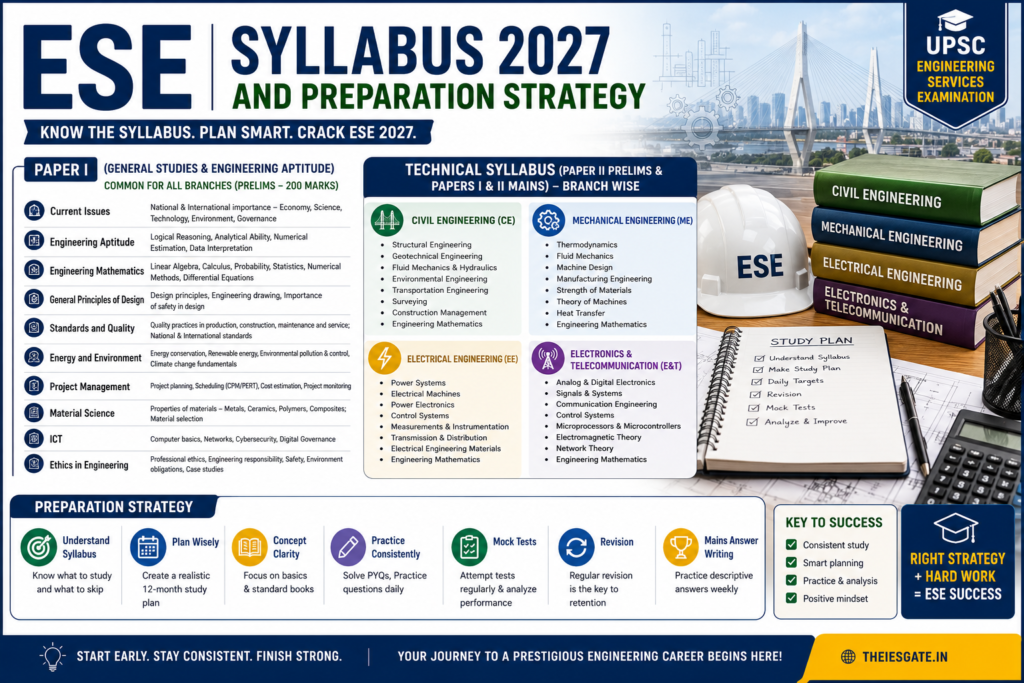
ESE Syllabus 2027 and Preparation Strategy — Subject-by-Subject Breakdown
Understanding the ESE syllabus before you start preparation is not optional — it is the foundation every hour of study sits on. Students who begin without a clear syllabus map waste months covering topics that carry little weight or revising areas they already know well.
This guide covers the complete ESE 2027 syllabus across all four eligible branches, explains the Paper I (General Studies) topics in detail, and lays out a preparation strategy that addresses both the objective Prelims and the descriptive Mains in a single integrated plan.
Part of our Complete ESE / IES Guide for 2027.
ESE 2027 Syllabus Structure
The ESE syllabus has two layers:
- Paper I — General Studies and Engineering Aptitude. This is identical for all four branches and is tested only in the Prelims.
- Paper II (Prelims) and Papers I & II (Mains) — Engineering Discipline-specific technical content. This varies by branch.
Paper I — General Studies and Engineering Aptitude Syllabus
Paper I is 200 marks in the Prelims and is a common paper for all branches. It is often underestimated by candidates who focus exclusively on technical subjects — this is a mistake. Paper I can swing your Prelims rank significantly in either direction.
Topic-Wise Breakdown
| Topic Area | Key Subtopics |
|---|---|
| Current Issues | National and international importance — economy, science, technology, environment, governance |
| Engineering Aptitude | Logical reasoning, analytical ability, numerical estimation, data interpretation |
| Engineering Mathematics | Linear Algebra, Calculus, Probability, Statistics, Numerical Methods, Differential Equations |
| General Principles of Design | Design principles, engineering drawing, importance of safety in design |
| Standards and Quality | Quality practices in production, construction, maintenance and service; national and international standards |
| Energy and Environment | Energy conservation, renewable energy basics, environmental pollution and control, climate change fundamentals |
| Project Management | Basics of project planning, scheduling (CPM/PERT), cost estimation, project monitoring |
| Material Science | Properties of engineering materials — metals, ceramics, polymers, composites; material selection principles |
| ICT | Basics of computer hardware, software, networks, cybersecurity awareness, digital governance |
| Ethics in Engineering | Professional ethics, engineering responsibility, safety and environment obligations, case studies |
Preparation Approach for Paper I
Treat Paper I as a scoring opportunity, not a burden. The Engineering Mathematics and Aptitude sections overlap significantly with GATE preparation — students preparing for both exams simultaneously benefit here. For Current Affairs, maintain a monthly reading habit using The Hindu or Indian Express supplemented by a monthly current affairs digest. Ethics and Environment topics can be covered in 3–4 weeks of focused reading once the rest of the syllabus is underway.
Technical Syllabus — Branch-Wise Breakdown
Civil Engineering (CE)
High-weightage subjects in ESE CE include Structural Analysis, Geotechnical Engineering, and Transportation Engineering. The descriptive Mains requires not just answers but proper diagrams, calculations, and justified assumptions.
| Subject | Key Topics |
|---|---|
| Engineering Mathematics | Linear Algebra, Differential Equations, Numerical Methods, Probability |
| Structural Engineering | Mechanics, SOM, Structural Analysis, Steel Structures, Concrete Structures |
| Geotechnical Engineering | Soil classification, permeability, consolidation, shear strength, foundations |
| Fluid Mechanics and Hydraulics | Flow equations, pipe flow, open channel flow, hydraulic machines |
| Environmental Engineering | Water treatment, wastewater, solid waste, air pollution |
| Transportation Engineering | Highway design, traffic engineering, railway engineering, airport design |
| Surveying | Levelling, theodolite, GPS, remote sensing |
| Construction Management | Project planning, CPM/PERT, contracts, estimation |
Mechanical Engineering (ME)
| Subject | Key Topics |
|---|---|
| Engineering Mathematics | Calculus, Linear Algebra, Differential Equations, Numerical Methods |
| Thermodynamics | Laws of thermodynamics, cycles, refrigeration, psychrometrics |
| Fluid Mechanics | Bernoulli, viscous flow, turbomachinery, compressible flow |
| Strength of Materials | Stress-strain, beams, columns, torsion, failure theories |
| Theory of Machines | Kinematics, dynamics, governors, flywheels, vibrations |
| Machine Design | Fatigue, welded joints, bearings, gears, shafts, springs |
| Manufacturing Engineering | Casting, forming, machining, metrology, quality |
| Heat Transfer | Conduction, convection, radiation, heat exchangers |
| Engineering Materials | Properties, phase diagrams, heat treatment |
Electrical Engineering (EE)
| Subject | Key Topics |
|---|---|
| Engineering Mathematics | Complex variables, Laplace, Fourier, Linear Algebra, Probability |
| Electric Circuits | Network theorems, transient analysis, 3-phase circuits, two-port networks |
| Electromagnetic Fields | Electrostatics, Magnetics, Maxwell’s equations, transmission lines |
| Electrical Machines | DC machines, transformers, induction motors, synchronous machines |
| Power Systems | Load flow, fault analysis, stability, protection, HVDC |
| Control Systems | Transfer functions, stability, Bode, Root Locus, state space |
| Power Electronics | Converters, inverters, choppers, drives |
| Analog and Digital Electronics | Op-amps, filters, logic families, combinational and sequential circuits |
| Measurements and Instrumentation | Bridges, transducers, oscilloscopes, data acquisition |
Electronics and Telecommunication Engineering (E&T)
| Subject | Key Topics |
|---|---|
| Engineering Mathematics | Complex Analysis, Probability, Signals, Fourier, Z-transform |
| Basic Electronics | Semiconductor physics, diodes, BJT, FET, op-amp circuits |
| Signals and Systems | Fourier, Laplace, Z-transform, sampling theorem, filters |
| Network Theory | KVL/KCL, network theorems, two-port, transient analysis |
| Electronic Measurements | Oscilloscopes, spectrum analyzers, signal generators |
| Communication Systems | AM, FM, PCM, digital modulation, noise, Shannon’s theorem |
| Microprocessors and Digital Systems | 8085/8086, memory interfacing, peripherals, digital circuits |
| Electromagnetics | Transmission lines, waveguides, antennas, propagation |
| Control Systems | Transfer functions, root locus, frequency response, stability |
ESE 2027 Preparation Strategy
Phase 1 — Foundation Building (Months 1–5)
Begin with Engineering Mathematics, as it appears in both Paper I (Prelims) and the technical paper. Strong mathematics is a multiplier across every subject that follows.
Cover the technical syllabus systematically — one subject at a time, completing all topics before moving to the next. Avoid the common mistake of studying many subjects simultaneously without depth in any. At the end of each subject, solve 50–80 previous year ESE questions from that subject to confirm understanding.
Simultaneously, spend 30 minutes daily on Paper I topics. Current affairs compound over time — starting early means less pressure in the final months.
Phase 2 — Practice and Mains Orientation (Months 6–10)
This phase shifts from input to output. The Mains requires descriptive written answers — this is a skill separate from conceptual understanding and requires dedicated practice.
- Write out complete answers to previous year Mains questions — full derivations, diagrams labelled, assumptions stated
- Take subject-wise Prelims mock tests every week — track accuracy by topic
- Identify your weakest two or three subjects and allocate 60% of revision time to them
- Form a consistent daily schedule: 3 hours technical, 1 hour Paper I, 1 hour answer writing practice
Phase 3 — Consolidation and Mock Tests (Months 11–12)
- Full-length Prelims mock tests under actual exam conditions — both papers back to back
- Analyse every wrong answer: concept gap or careless error? Address separately
- Consolidate short revision notes for high-weightage topics in each subject
- Complete 10–15 full Mains answer papers — time yourself, focus on presentation and diagram quality
Common Preparation Mistakes to Avoid
- Ignoring Paper I until the end. General Studies accounts for 200 marks in Prelims and significantly influences shortlisting. Students who treat it as an afterthought often miss the Mains cutoff by narrow margins.
- Studying for Prelims only. The Mains descriptive format requires a different skill — written depth, diagrammatic clarity, structured answers. Starting Mains-style practice only after Prelims results is too late.
- Covering too many books per subject. One standard textbook per subject, reinforced with previous year questions and coaching notes, is more effective than collecting five books and reading none thoroughly.
- No mock test discipline. Many students complete the syllabus but take very few mock tests. Without timed practice, speed and accuracy under pressure don’t develop.
Next in the ESE Series
- ESE vs GATE — Which Should You Attempt in 2027?
- ESE Coaching in Chennai — What a Structured Program Should Cover
- Back to the Complete ESE / IES Guide
Frequently Asked Questions
Is the ESE syllabus the same every year?
Yes. UPSC has not changed the ESE syllabus significantly since 2017. The broad subject areas and topics remain consistent. Minor variations in question style may occur, but the syllabus itself is stable. Candidates should verify the official UPSC notification each year before finalising their preparation plan.
How many hours per day should I study for ESE?
Most successful ESE candidates study 8–10 hours per day during active preparation, with Sundays reserved for mock tests and weekly review. Quality and consistency matter more than raw hours — 6 focused hours daily with proper revision is more effective than 10 unfocused hours.
Should I prepare for ESE and GATE simultaneously?
Yes, if your branch is eligible for both. The technical syllabus overlap is approximately 60–70%. Combined preparation is efficient — you build technical depth for both exams simultaneously, then add the ESE-specific elements (Paper I, descriptive Mains practice) on top. Many Chennai students from CE, ME, EE, and ECE backgrounds target both.
How important are previous year questions in ESE preparation?
Extremely important — especially for the Mains. ESE tends to repeat question patterns and tests the same core concepts in different forms. Solving the last 10–15 years of previous papers (both Prelims and Mains) gives you a clear picture of what is actually tested and how answers should be structured.