
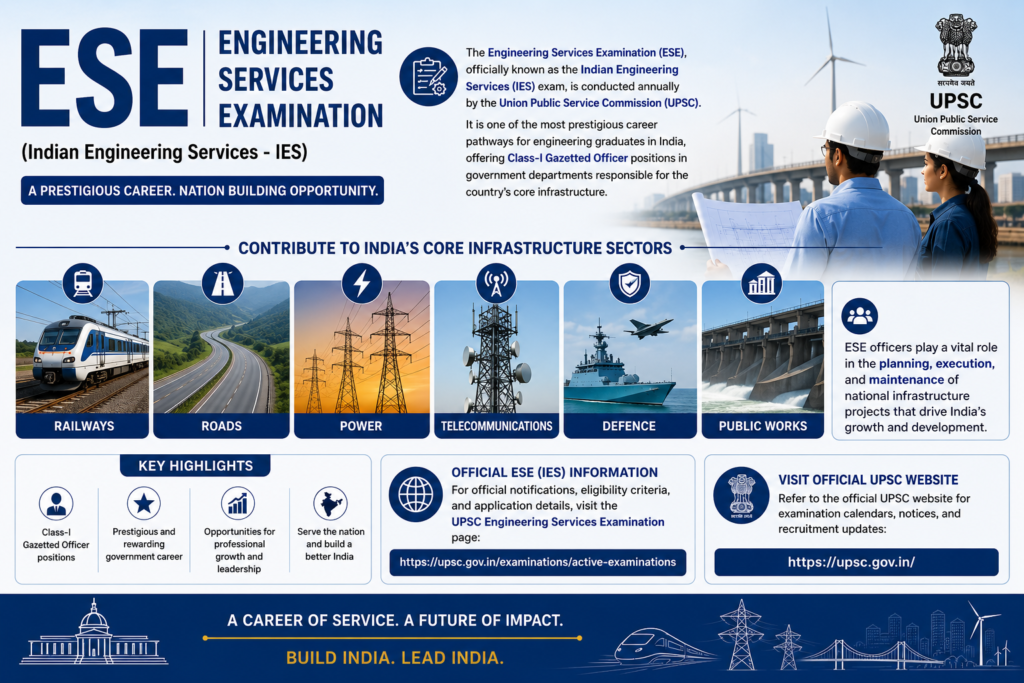
ESE / IES Exam 2027 — Complete Guide for Engineering Aspirants
The Engineering Services Examination (ESE), officially known as the Indian Engineering Services (IES) exam, is conducted annually by the Union Public Service Commission (UPSC). It is one of the most prestigious career pathways for engineering graduates in India — offering Class-I Gazetted Officer positions in government departments that run the country’s core infrastructure.
If you are an engineering student in Chennai asking whether ESE is the right exam for you, this guide covers everything: what the exam is, who can appear, how it is structured, what the syllabus looks like, and how to build a preparation strategy that works.
What is the ESE / IES Exam?
The Engineering Services Examination (ESE) is a national-level competitive exam conducted by UPSC to recruit engineers as Group A and Group B Gazetted Officers under the Government of India. Officers selected through ESE are posted to technical departments such as:
- Indian Railways (Railway Service of Engineers)
- Central Public Works Department (CPWD)
- Central Water Engineering Service
- Indian Defence Service of Engineers
- Indian Telecommunications Service
- Border Roads Engineering Service
- Military Engineer Services (MES)
IES officers are responsible for planning, designing, executing, and managing large-scale infrastructure projects. The scale of work — railways, dams, national highways, defence installations, telecom networks — makes ESE one of the most impactful engineering careers available in India.
The exam is popularly called IES (Indian Engineering Services) though the official UPSC name is ESE (Engineering Services Examination). Both refer to the same examination.
ESE 2027 Eligibility Criteria
Educational Qualification
Candidates must hold a degree in Engineering — B.E. or B.Tech — from a recognised university. Students in their final year of the engineering degree are also eligible to appear for the preliminary examination, subject to producing proof of passing before the mains stage.
ESE is conducted for four engineering disciplines only:
- Civil Engineering
- Mechanical Engineering
- Electrical Engineering
- Electronics and Telecommunication Engineering
Students from other branches (Computer Science, Chemical, Aerospace, etc.) are not eligible to appear for ESE. If your branch is outside these four, GATE + PSU or GATE + M.Tech is the relevant path.
Age Limit
Candidates must be between 21 and 30 years of age as on the 1st of January of the examination year. Age relaxation applies as follows:
- SC / ST candidates: 5 years relaxation (up to 35 years)
- OBC candidates: 3 years relaxation (up to 33 years)
- PwBD candidates: 10 years relaxation
Nationality
Candidates must be Indian citizens. Certain categories of foreign nationals — Tibetan refugees, persons of Indian origin from specified countries — may also be eligible subject to additional UPSC conditions.
Number of Attempts
There is no restriction on the number of attempts for ESE, as long as the candidate satisfies the age criteria on each occasion.
ESE 2027 Exam Pattern — Stages and Structure
ESE 2027 is conducted in three stages:
Stage 1: Preliminary Examination
The ESE Prelims consists of two objective papers conducted on the same day:
| Paper | Subject | Marks | Duration |
|---|---|---|---|
| Paper I | General Studies and Engineering Aptitude | 200 | 2 hours |
| Paper II | Engineering Discipline (CE / ME / EE / E&T) | 300 | 3 hours |
Both papers are objective (multiple choice). Negative marking of 1/3 mark applies for incorrect answers. The ESE Prelims 2027 is scheduled for 20th February 2027.
Stage 2: Mains Examination
Candidates who clear Prelims appear for the Mains, which is a descriptive (conventional) exam consisting of two papers:
| Paper | Subject | Marks | Duration |
|---|---|---|---|
| Paper I | Engineering Discipline — Part A | 300 | 3 hours |
| Paper II | Engineering Discipline — Part B | 300 | 3 hours |
The Mains exam requires descriptive answers — diagrams, derivations, applied problem solving. It tests depth of conceptual understanding, not just recall. The ESE Mains 2027 is scheduled for 30th June 2027.
Stage 3: Personality Test (Interview)
Candidates shortlisted after Mains appear for a Personality Test conducted by UPSC. The interview carries 200 marks. Final selection is based on the combined merit score of Mains + Interview.
ESE 2027 Syllabus Overview
Paper I — General Studies and Engineering Aptitude (Common for All Branches)
This paper is common regardless of your engineering discipline. Topics include:
- Current issues of national and international importance
- Engineering Aptitude covering Logical Reasoning and Analytical Ability
- Engineering Mathematics and Numerical Analysis
- General Principles of Design, Drawing, Importance of Safety
- Standards and Quality Practices in Production, Construction, Maintenance
- Basics of Energy and Environment — Conservation, Environmental Pollution
- Basics of Project Management
- Basics of Material Science and Engineering
- Information and Communication Technologies (ICT)
- Ethics and Values in Engineering Profession
Paper II — Technical Discipline Syllabus
The technical paper syllabus varies by branch. All four disciplines share a common structure — Engineering Mathematics (Linear Algebra, Calculus, Differential Equations, Numerical Methods) forms a significant portion, followed by core technical subjects specific to each branch.
For detailed branch-wise syllabus breakdowns, refer to our dedicated cluster articles:
- ESE Eligibility and Exam Pattern — Detailed Breakdown
- ESE Syllabus and Preparation Strategy
- ESE vs GATE — Which Should You Attempt?
- ESE Coaching — What to Look For
ESE vs GATE — Key Differences
Many engineering students from Chennai’s top colleges — Anna University, College of Engineering Guindy, SSN, Sathyabama — wonder whether to target ESE or GATE. Both are prestigious but they serve different purposes.
| Factor | ESE / IES | GATE |
|---|---|---|
| Conducted by | UPSC | IITs / IISc |
| Outcome | Government job (Class-I Officer) | M.Tech admission / PSU job |
| Branches eligible | CE, ME, EE, E&T only | 29 disciplines |
| Exam type | Objective + Descriptive + Interview | Objective only (CBT) |
| Vacancies (approx.) | ~167 posts per year | Thousands of seats / PSU openings |
| Competition level | Extremely high — fewer posts | High — more opportunities |
| Syllabus overlap | ~60–70% overlap with GATE technical | — |
| Starting salary | ₹56,100/month + allowances (Level 10) | Varies (PSU: ₹40,000–₹80,000+) |
Many serious aspirants prepare for both GATE and ESE simultaneously — the technical syllabus overlap is around 60–70%, making combined preparation efficient. The key difference is ESE additionally requires General Studies (Paper I) and conventional descriptive answers in Mains.
For a complete comparison and decision framework, read our dedicated article: ESE vs GATE — Which Exam Should You Attempt in 2027?
Career and Salary After Clearing ESE / IES
Engineers selected through ESE are appointed as Class-I Gazetted Officers. The 7th Pay Commission revised IES pay scales significantly, bringing them close to IAS-level salaries at senior grades.
Pay Scale at Entry Level
IES officers are appointed at Level 10 of the Central Pay Matrix — a basic pay of ₹56,100 per month. In addition to basic pay, officers receive:
- Dearness Allowance (DA)
- House Rent Allowance (HRA)
- Transport Allowance
- Medical benefits
- Government accommodation (in most postings)
The total monthly compensation at entry level typically ranges from ₹80,000 to ₹1,10,000 depending on posting location and allowances.
Career Growth
IES officers follow a structured promotion path: Junior Engineer → Assistant Executive Engineer → Executive Engineer → Superintending Engineer → Chief Engineer. Senior positions (SE, CE) carry Level 13–14 pay — equivalent to Joint Secretary level in IAS.
Departments and Work Profile
The nature of work depends on the service you are allotted. Railway engineers work on track design, bridge construction, and rolling stock. CPWD engineers manage government buildings and central infrastructure. Defence engineers work on military installations. The work is technically demanding, has real national-scale impact, and comes with significant administrative authority.
How to Prepare for ESE 2027 — Strategy Overview
ESE preparation demands more time than GATE because of three additional requirements: General Studies (Paper I), the descriptive Mains format, and the Personality Test. A realistic preparation window is 12–18 months for a first attempt.
Phase 1 — Foundation (Months 1–4)
- Complete the technical syllabus (Paper II) with strong conceptual clarity — do not rush through topics
- Simultaneously start General Studies (Paper I) — Current affairs, engineering aptitude, ethics
- Solve previous year Prelims questions to understand question style and difficulty
Phase 2 — Depth and Practice (Months 5–9)
- Shift to conventional descriptive practice — write out derivations, design solutions, applied problems
- Take subject-wise mock tests for both Paper I and Paper II
- Identify weak subjects and allocate additional revision time
Phase 3 — Revision and Mock Tests (Months 10–12)
- Full-length Prelims mock tests under timed conditions
- Conventional question practice for Mains — speed and presentation both matter
- Current affairs consolidation for Paper I
- Personality Test preparation — communication, technical clarity, current affairs
Key Subjects by Branch
Regardless of your discipline, Engineering Mathematics and Paper I (General Studies) are common high-weightage areas. For the technical paper, high-yield subjects typically include Strength of Materials (CE), Thermodynamics (ME), Power Systems (EE), and Signal Systems (E&T).
For a complete month-by-month study plan and subject prioritisation, see: ESE Syllabus and Preparation Strategy for 2027
ESE Coaching
Structured coaching for ESE is important for two reasons that self-study often misses: the descriptive Mains format requires guided practice and evaluated feedback, and General Studies (Paper I) requires a current affairs system that is hard to maintain alone.
At IES GATE Training Academy, our ESE coaching program covers both the technical and General Studies components in an integrated format. Our faculty includes IIT and NIT graduates with specific ESE examination experience. Students preparing for ESE at our Mogappair, Tambaram, Ekkattuthangal and Thoraipakkam branches benefit from structured weekly tests, descriptive answer writing practice, and one-on-one performance review sessions.
If you are in Chennai and targeting ESE 2027, enquire about our ESE coaching program here or call +91 72990 77859.
Frequently Asked Questions — ESE / IES Exam
What is the difference between ESE and IES?
There is no difference — both names refer to the same examination. ESE stands for Engineering Services Examination (the official UPSC name). IES stands for Indian Engineering Services (the popular name). UPSC has increasingly used ESE in official communications, but IES remains widely used by students and coaching institutes.
Which engineering branches are eligible for ESE?
Only four branches are eligible: Civil Engineering, Mechanical Engineering, Electrical Engineering, and Electronics and Telecommunication Engineering. Students from other disciplines — Computer Science, Chemical, Aerospace, Biotechnology — are not eligible for ESE.
Can final-year students apply for ESE 2027?
Yes. Students in the final year of their B.E. / B.Tech degree can appear for the Preliminary examination. However, they must produce proof of passing their degree before appearing for the Mains examination.
How many vacancies are available in ESE 2027?
ESE Prelims 2027 is scheduled to recruit for approximately 167 posts across the four eligible engineering disciplines. The exact number is announced in the official UPSC ESE 2027 notification released in September 2026.
Is it possible to prepare for both GATE and ESE simultaneously?
Yes, and many students do. The technical syllabus overlap between GATE and ESE Paper II is approximately 60–70%. The additional preparation required for ESE involves Paper I (General Studies), the descriptive Mains format, and the interview. A structured coaching program can integrate both effectively.
What is the salary of an IES officer after selection?
IES officers are appointed at Level 10 of the 7th Pay Commission matrix — a basic pay of ₹56,100 per month. Total monthly compensation including DA, HRA, and other allowances typically ranges from ₹80,000 to ₹1,10,000 at entry level, depending on posting location.
How many attempts are allowed for ESE?
There is no limit on the number of attempts for ESE. Candidates can appear as many times as they wish, provided they satisfy the age criteria (21–30 years, with relaxations for reserved categories) on each occasion