
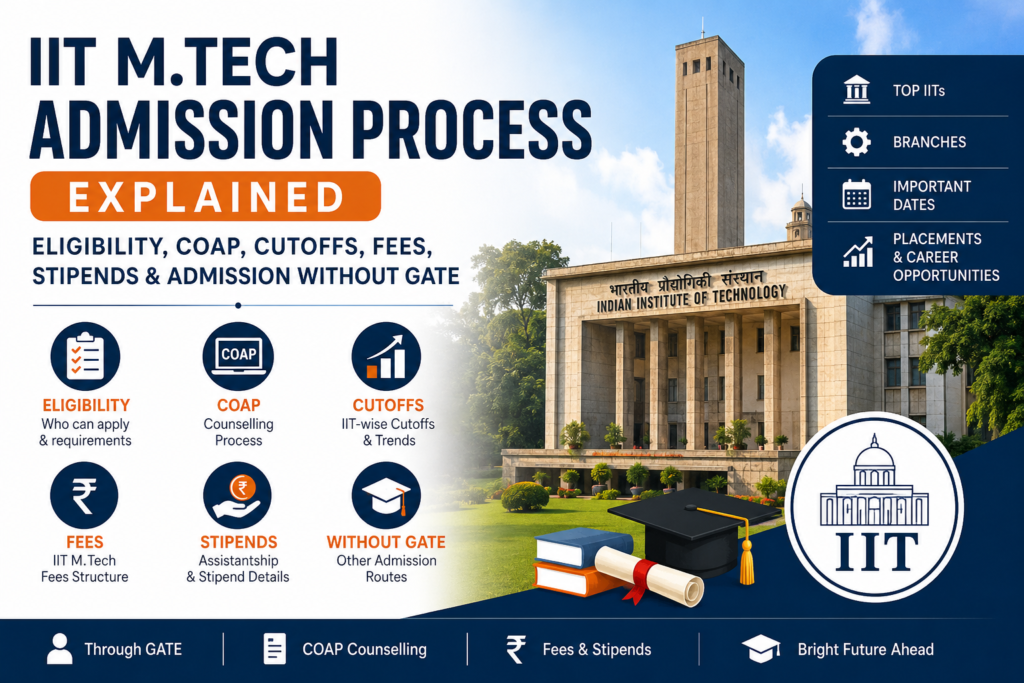
IIT M.Tech Admission Process Explained: Eligibility, COAP, Cutoffs, Fees, Stipends & Admission Without GATE
For engineering graduates aiming to pursue higher education at India’s premier institutes, understanding the IIT M.Tech admission process is essential. Admission to M.Tech programs at the Indian Institutes of Technology (IITs) is primarily based on a valid GATE score, followed by institute-specific applications and participation in the Common Offer Acceptance Portal (COAP).
A strong GATE score can unlock opportunities for admission into top IITs, specialized engineering programs, research careers, PhD pathways, PSU recruitment opportunities, and advanced technical roles across industries.
Preparing for GATE in Chennai? IES GATE Training Academy offers structured coaching for GATE, PSU, and M.Tech admissions across 13 engineering streams with expert faculty from IITs and NITs.
In this comprehensive guide, you’ll learn everything about IIT M.Tech admissions including eligibility criteria, COAP counselling, GATE score requirements, admission categories, stipend benefits, placement opportunities, and admission without GATE.
What Is the IIT M.Tech Admission Process?
IIT M.Tech admission is the postgraduate engineering admission process conducted by individual IITs. Most candidates secure admission through a valid GATE score, followed by institute-specific applications and participation in COAP (Common Offer Acceptance Portal). Certain categories, such as sponsored candidates and eligible IIT graduates, may also gain admission without GATE.
The Master of Technology (M.Tech) is a postgraduate engineering degree offered by IITs across multiple specializations including Computer Science, Artificial Intelligence, Machine Learning, VLSI Design, Structural Engineering, Power Systems, Manufacturing, Data Science, Robotics, Cyber Security, and more.
Unlike undergraduate admissions conducted through centralized counselling, IIT M.Tech admissions require candidates to apply separately to individual IITs while also participating in COAP for offer management.
The admission ecosystem involves several stakeholders:
- Indian Institutes of Technology (IITs)
- Indian Institute of Science (IISc)
- GATE Organizing Institute
- COAP (Common Offer Acceptance Portal)
- Ministry of Education
Understanding how these systems work together can significantly improve your admission chances.
Why Is IIT M.Tech Considered One of the Best Career Options After GATE?
IIT M.Tech programs provide advanced technical specialization, excellent placement opportunities, research exposure, access to world-class faculty, industry collaborations, PhD pathways, and global career opportunities. For many engineering graduates, an IIT M.Tech degree serves as a powerful accelerator for long-term career growth.
Students often view GATE as an examination for M.Tech admissions, but its value extends far beyond securing a postgraduate seat.
Research Opportunities
IITs host cutting-edge research centers in emerging technologies such as Artificial Intelligence, Semiconductor Technology, Quantum Computing, Renewable Energy, Robotics, and Smart Manufacturing.
Higher Salary Potential
M.Tech graduates from top IITs frequently receive opportunities from leading technology firms, product companies, consulting organizations, and core engineering industries.
PhD and Academic Pathways
An IIT M.Tech degree creates a strong foundation for doctoral research, academic careers, and specialized technical consulting.
PSU and Government Opportunities
Many students combine higher education with PSU career aspirations. Learn more through our guide on PSU Recruitment Through GATE Score.
Global Opportunities
IIT graduates often pursue research collaborations, international fellowships, higher education abroad, and careers with multinational organizations.
Related Reading: Career Opportunities Through GATE Examination
Who Is Eligible for IIT M.Tech Admission?
Candidates holding a B.E., B.Tech, integrated degree, MSc, or equivalent qualification in a relevant discipline are generally eligible for IIT M.Tech admissions. Most applicants require a valid GATE score, although eligibility criteria may vary by institute and department.
Educational Qualifications
B.E. Graduates
Candidates with Bachelor of Engineering degrees from recognized institutions are generally eligible for relevant M.Tech programs.
B.Tech Graduates
B.Tech degree holders constitute the largest applicant group for IIT M.Tech admissions.
Integrated Degree Holders
Integrated B.Tech-M.Tech and dual-degree candidates may be eligible based on institute-specific criteria.
MSc Candidates
Some interdisciplinary and science-focused programs accept MSc graduates with relevant academic backgrounds.
Architecture Graduates
Certain specialized programs accept B.Arch graduates, particularly in planning, design, infrastructure, and related disciplines.
Minimum CGPA Requirements
| Institute Type | Typical Requirement |
|---|---|
| IIT Graduates | 8.0 CGPA or higher (varies by institute) |
| Other Universities | Degree completion with qualifying criteria |
| Sponsored Candidates | Relevant work experience |
Always verify department-specific eligibility because requirements may differ between specializations and institutes.
IIT M.Tech Admission Timeline After GATE
The IIT M.Tech admission process typically begins after GATE results are declared. Candidates apply to IITs, register for COAP, participate in multiple counselling rounds, and complete admissions between March and August.
| Stage | Typical Timeline |
|---|---|
| GATE Examination | February |
| Result Declaration | March |
| IIT Applications Open | March–April |
| COAP Registration | March–April |
| Department Shortlisting | April–May |
| COAP Rounds Begin | May–June |
| Additional Rounds | June–July |
| Final Admissions | July–August |
| Classes Commence | July–August |
Important Timeline Considerations
- Different IITs release applications on different dates.
- Some departments conduct interviews or written tests.
- Additional admission rounds may continue beyond initial COAP rounds.
- Late applications are rarely accepted.
One of the most common mistakes students make is assuming all IITs follow identical schedules. Always monitor institute admission portals carefully.
How Does IIT M.Tech Admission Work Step-by-Step?
IIT M.Tech admissions involve qualifying GATE, applying separately to IITs, registering on COAP, participating in offer rounds, completing document verification, and finalizing admission at the allotted institute.
Step 1: Appear for GATE
GATE serves as the primary admission gateway for most M.Tech programs. Higher scores significantly improve admission opportunities.
Step 2: Check GATE Results
Once results are declared, evaluate your score, rank, normalized marks, and expected admission prospects.
Related Guide: GATE Score vs Rank vs Marks Explained
Step 3: Apply Separately to IITs
Critical Misconception: Many students mistakenly believe COAP alone is sufficient.
COAP does not replace institute applications. Candidates must submit separate applications to every IIT they wish to join.
Step 4: Register on COAP
Eligible GATE-qualified candidates must register on the Common Offer Acceptance Portal.
Step 5: Participate in COAP Rounds
Admission offers are released in multiple rounds. Candidates must actively respond to offers within specified deadlines.
Step 6: Accept an Offer
Based on available options, candidates may accept, retain, or reject offers according to COAP rules.
Step 7: Document Verification
Selected candidates undergo verification of academic records, category certificates, identity proof, and other required documents.
Step 8: Final Admission
After successful verification and fee payment, candidates receive final admission confirmation from the institute.
What Is COAP and Why Is It Mandatory?
COAP (Common Offer Acceptance Portal) is a centralized platform used by participating IITs and institutions to manage M.Tech admission offers. Candidates with valid GATE scores must register on COAP to view, accept, retain, or reject admission offers.
Full Form of COAP
COAP = Common Offer Acceptance Portal
COAP is not a counselling platform like CCMT. Instead, it acts as an offer management system for GATE-qualified candidates.
How COAP Works
GATE Score → IIT Application → COAP Registration → Offer Release → Candidate Decision → Final Admission
Once institutes complete shortlisting, admission offers are published through COAP.
COAP Options Explained
Accept and Freeze
The candidate accepts the current offer and exits future consideration.
Retain and Wait
The candidate keeps the current offer while remaining eligible for higher-preference offers.
Reject and Wait
The candidate declines the current offer and waits for future opportunities.
Multiple Offer Handling
COAP helps candidates manage multiple admission offers efficiently through a single portal.
Common COAP Mistakes
- Missing COAP registration deadlines
- Entering incorrect GATE details
- Ignoring offer response deadlines
- Not understanding Retain & Wait rules
- Assuming COAP replaces IIT applications
Detailed Guide: Complete COAP Counselling Guide
What GATE Score Is Required for IIT M.Tech Admission?
Direct Answer: There is no universal GATE score cutoff for IIT M.Tech admissions. Required scores vary by IIT, branch, specialization, category, and applicant competition each year. However, candidates with scores above 750 generally have strong admission prospects, while scores above 850 are often competitive for top IITs and highly sought-after branches.
One of the biggest misconceptions among GATE aspirants is assuming a fixed score guarantees admission. In reality, IIT admissions depend on multiple factors including department-level cutoffs, seat availability, applicant quality, category reservation, and interview performance where applicable.
| GATE Score Range | Admission Probability |
|---|---|
| 850+ | Excellent for Top IITs & Top Branches |
| 750–850 | Very High |
| 650–750 | Good IIT Opportunities |
| 550–650 | Moderate Opportunities |
| Below 550 | Limited Opportunities |
Factors Affecting IIT M.Tech Cutoffs
Branch Effect
Computer Science Engineering (CSE), Artificial Intelligence, Data Science, and VLSI programs typically require higher GATE scores compared to several traditional specializations.
Category Effect
Admission cutoffs vary across General, OBC-NCL, EWS, SC, ST, and PwD categories according to Government of India reservation policies.
Institute Effect
Older IITs generally have higher competition levels compared to newer IITs due to stronger brand recognition, research output, and placement opportunities.
Related Reading: GATE Cutoff Explained
IIT M.Tech Admission Process at Different IITs
While all IITs primarily use GATE scores for M.Tech admissions, each institute follows its own selection methodology. Some IITs admit students solely through GATE scores, while others conduct written tests, interviews, department screening, or additional evaluation processes.
IIT Madras Admission Process
Indian Institute of Technology Madras primarily admits candidates through GATE scores and institute-level applications. Certain categories of IIT graduates may receive direct admission based on CGPA requirements.
GATE Route
- Valid GATE Score
- Institute Application
- COAP Participation
- Final Admission Offer
Direct Admission for IIT Graduates
Eligible IIT graduates meeting prescribed CGPA criteria may apply without GATE for selected programs.
IIT Bombay Admission Process
Indian Institute of Technology Bombay uses GATE scores as the primary shortlisting criterion. Some departments may conduct interviews, written tests, or additional evaluations.
- Departmental Screening
- Program-Specific Interviews
- Research-Oriented Assessments
IIT Delhi Admission Process
Indian Institute of Technology Delhi may conduct written tests or interviews for selected M.Tech programs.
- GATE-Based Shortlisting
- Written Tests (Selected Programs)
- Department Interviews
IIT Kanpur Admission Process
IIT Kanpur follows department-specific admission criteria. Selection methods vary across specializations.
- GATE Score Evaluation
- Department Screening
- Research Potential Assessment
IIT Kharagpur Admission Process
IIT Kharagpur uses program-specific shortlisting processes depending on department requirements.
- GATE-Based Selection
- Additional Screening Parameters
- Specialization-Specific Evaluation
IIT Roorkee Admission Process
IIT Roorkee often applies department-level eligibility filters before issuing offers.
- Eligibility Screening
- GATE-Based Merit
- Department Verification
Important: Admission policies can change annually. Always verify current admission brochures before applying.
Can You Get IIT M.Tech Admission Without GATE?
Yes. Certain categories of candidates can obtain IIT M.Tech admission without GATE, including eligible IIT graduates with high CGPA, sponsored candidates, QIP candidates, project staff members, and research professionals. However, regular admissions for most applicants continue to require a valid GATE score.
Many students search for “IIT M.Tech without GATE” hoping for a shortcut. In reality, non-GATE admission routes exist but are limited and highly category-specific.
IIT Graduates with High CGPA
Several IITs permit direct admission for their own B.Tech graduates who meet minimum CGPA requirements, often around 8.0 or above.
Sponsored Candidates
Working professionals sponsored by government organizations, PSUs, research laboratories, or private companies may apply under sponsored categories.
QIP Candidates
The Quality Improvement Programme (QIP) enables faculty members from engineering institutions to pursue higher education without following standard admission routes.
Research Staff Category
Research personnel working in approved institutions may qualify under special admission categories.
Industry Professionals
Experienced professionals may be eligible for part-time, sponsored, or executive M.Tech programs depending on institute regulations.
Limitations of Non-GATE Admissions
- Limited seat availability
- Restricted program options
- Category-specific eligibility
- Additional documentation requirements
- Employer sponsorship requirements
What Are the Different Categories of IIT M.Tech Admissions?
IITs offer multiple admission categories including Regular, Sponsored, Project Staff, Research Scholar, and QIP admissions. Eligibility, GATE requirements, funding, and work experience requirements vary across categories.
| Category | GATE Required | Experience Required |
|---|---|---|
| Regular | Yes | No |
| Sponsored | No | Yes |
| Project Staff | Sometimes | Yes |
| Research Scholar | Varies | Varies |
| QIP | Usually No | Yes |
Regular Category
The most common admission route based on GATE performance and institute selection procedures.
Sponsored Category
Suitable for employed professionals supported by their organizations.
Project Staff Category
Designed for candidates working on sponsored research projects within institutions.
Research Scholar Category
Targets candidates involved in advanced research activities.
QIP Category
Primarily serves engineering faculty seeking advanced qualifications.
Branch-Wise IIT M.Tech Admission Trends
Admission competitiveness varies significantly across engineering disciplines. Computer Science, Artificial Intelligence, Data Science, VLSI, and Semiconductor-related programs typically experience the highest demand, while traditional branches continue to offer strong opportunities in research and core engineering sectors.
Computer Science Engineering (CSE)
- Highest competition levels
- Strong placement opportunities
- AI & Machine Learning focus
- Data Science demand
- Cyber Security specialization growth
CSE programs consistently attract top GATE scorers due to technology sector demand.
Electronics and Communication Engineering (ECE)
- VLSI Design
- Embedded Systems
- Semiconductor Industry Growth
- Communication Systems
- Chip Design Opportunities
India’s semiconductor ecosystem expansion has significantly increased demand for VLSI and embedded systems professionals.
Electrical Engineering (EEE)
- Power Systems
- Smart Grids
- Renewable Energy
- Control Systems
- Electric Vehicle Technologies
Mechanical Engineering
- Design Engineering
- Manufacturing Systems
- Thermal Engineering
- Automation
- Industrial Engineering
Civil Engineering
- Structural Engineering
- Transportation Engineering
- Geotechnical Engineering
- Water Resources
- Infrastructure Development
Chemical Engineering
- Process Engineering
- Petrochemicals
- Energy Systems
- Sustainable Manufacturing
Instrumentation Engineering
- Automation
- Industrial Control
- Robotics
- Process Monitoring
Aerospace Engineering
- Aerodynamics
- Propulsion Systems
- Space Technology
- Defense Applications
Popular IIT M.Tech Specializations
IITs offer a wide range of specialized M.Tech programs aligned with industry trends, research priorities, and emerging technologies. Selecting the right specialization is often more important than choosing an institute solely based on rankings.
| Branch | Popular Specializations |
|---|---|
| CSE | AI, ML, Data Science, Cyber Security |
| ECE | VLSI, Embedded Systems, Communication Systems |
| EEE | Power Systems, Control Systems, Smart Grids |
| Mechanical | Design Engineering, Thermal Engineering, Manufacturing |
| Civil | Structural Engineering, Transportation Engineering |
| Chemical | Process Engineering, Energy Systems |
| Aerospace | Aerodynamics, Propulsion, Space Systems |
How to Choose the Right Specialization
- Align with long-term career goals
- Evaluate industry demand
- Review faculty expertise
- Assess research opportunities
- Study placement records
- Consider PhD aspirations
A common mistake is selecting a specialization solely based on current salary trends. Long-term interest and technical aptitude should remain major decision factors.
Related Reading: Best IITs for M.Tech in India
What Are the IIT M.Tech Fees and Return on Investment (ROI)?
IIT M.Tech programs generally offer one of the best returns on investment among postgraduate engineering degrees in India. While fees vary across institutes and programs, the availability of GATE assistantships, strong placements, research opportunities, and industry recognition significantly improve overall ROI.| IIT | Approximate Program Fees* | ROI Level |
|---|---|---|
| IIT Madras | Moderate | High |
| IIT Bombay | Moderate | High |
| IIT Delhi | Moderate | High |
| IIT Kanpur | Moderate | High |
| IIT Kharagpur | Moderate | High |
Factors Influencing ROI
Placement Packages
Top IITs attract recruiters from product companies, consulting firms, semiconductor companies, research organizations, and core engineering industries.Research Opportunities
Students gain access to funded research projects, laboratories, patents, publications, and interdisciplinary innovation centers.International Prospects
An IIT M.Tech degree can strengthen applications for international PhD programs, global R&D roles, and research collaborations.What Is the M.Tech Stipend Through GATE?
Eligible GATE-qualified M.Tech students can receive a monthly assistantship of ₹12,400 subject to institute regulations, academic performance, attendance requirements, and assigned teaching or research responsibilities.Current Assistantship Amount
Eligible students generally receive ₹12,400 per month during the duration of their M.Tech program.Eligibility Conditions
- Valid GATE qualification
- Admission under eligible categories
- Institute approval
- Satisfactory academic progress
Teaching Assistant Duties
- Laboratory supervision
- Tutorial assistance
- Assignment evaluation support
- Departmental academic activities
Attendance Requirements
Students must satisfy attendance and departmental participation requirements as prescribed by their institute.Continuation Criteria
- Maintain required academic performance
- Complete assigned duties
- Follow institute regulations
- Meet departmental review standards
What Are the Placement Opportunities After IIT M.Tech?
IIT M.Tech graduates secure opportunities in product development, semiconductor design, software engineering, consulting, core engineering industries, research laboratories, startups, and public sector organizations. Placement outcomes vary by specialization, institute, market conditions, and individual performance.Product Companies
- Microsoft
- Amazon
- Adobe
- Oracle
- Salesforce
Semiconductor Companies
- DRDO (Defence Research and Development Organisation)
- ISRO (Indian Space Research Organisation)
- CSIR Laboratories (Council of Scientific & Industrial Research)
- BARC (Bhabha Atomic Research Centre)
- AICTE-Recognized Research Institutions and various National Research Institutes supported by the Ministry of Education, Government of India
- Research-focused students
- High GATE scorers
- Candidates targeting top placements
- Future PhD aspirants
- Candidates seeking strong academics
- Students with moderate GATE scores
- Cost-conscious learners
- Region-specific preferences
- GATE Scorecard
- Degree Certificate
- Semester Mark Sheets
- Aadhaar Card or Valid ID Proof
- Category Certificate (if applicable)
- Passport Size Photographs
- Application Forms
- Sponsorship Letter
- Experience Certificate
- No Objection Certificate (NOC)
- Project Staff Documentation
- Research Employment Records
- Start researching programs before GATE results.
- Track IIT application deadlines carefully.
- Register for COAP on time.
- Apply to multiple institutes strategically.
- Study branch-wise admission trends.
- Evaluate faculty, research, and placement opportunities.
- Understand category-specific eligibility requirements.
- Keep all documents ready before admissions begin.
- Careers After GATE Examination
- PSU Recruitment Through GATE Score
- GATE Score vs Rank vs Marks
- GATE Cutoff Explained
- COAP Counselling Guide
- GATE Scholarship Guide
- Higher Studies vs PSU Career
- Best IITs for M.Tech in India
Core Engineering Companies
Research Organizations
PSU Opportunities
Many students combine M.Tech qualifications with opportunities in government organizations and public sector enterprises. Related Reading: PSU Recruitment Through GATE ScoreIIT M.Tech vs NIT M.Tech: Which Is Better?
Both IITs and NITs offer strong M.Tech programs. IITs generally provide broader research ecosystems, higher competition, stronger global recognition, and larger recruiter participation, while NITs offer quality education at comparatively lower competition levels.| Factor | IIT M.Tech | NIT M.Tech |
|---|---|---|
| Competition | High | Moderate |
| Research Infrastructure | Strong | Good |
| Faculty Exposure | Strong | Good |
| Placements | Generally Higher | Good |
| Industry Collaborations | Extensive | Growing |
| Fees | Slightly Higher | Generally Lower |