
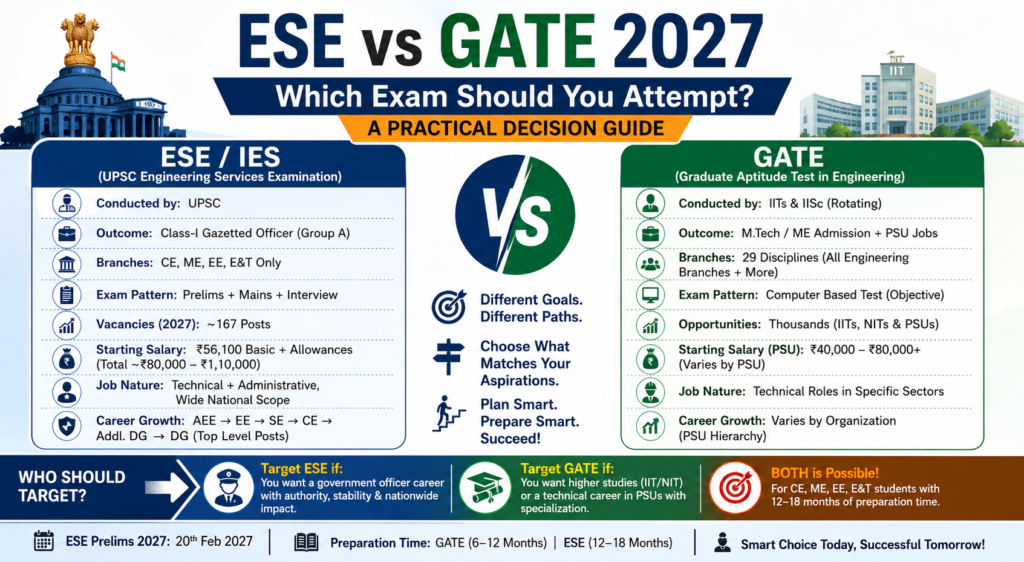
ESE vs GATE 2027 — Which Exam Should You Attempt? A Practical Decision Guide
Every year, thousands of engineering students in Chennai — especially those in Civil, Mechanical, Electrical, and ECE branches — face this question: should I target GATE, ESE, or both?
The answer is not one-size-fits-all. It depends on your branch, your career goal, your available preparation time, and how you weigh job security against academic pursuit. This article gives you a structured way to make that decision — not a generic answer, but the framework to arrive at your own.
Part of our Complete ESE / IES Guide for 2027.
The Fundamental Difference in One Line
GATE opens the door to M.Tech admissions at IITs/NITs and PSU recruitment. ESE is the pathway to becoming a Class-I Gazetted Officer in the Government of India’s engineering services. These are different outcomes, not different routes to the same destination.
Side-by-Side Comparison
| Factor | GATE | ESE / IES |
|---|---|---|
| Conducted by | IITs and IISc (rotating) | UPSC (Union Public Service Commission) |
| Primary outcome | M.Tech / ME admission + PSU jobs | Class-I Gazetted Officer post (Group A) |
| Eligible branches | 29 disciplines including CS, Chemical, Aerospace, Biotech, Instrumentation | 4 branches only: CE, ME, EE, Electronics & Telecom |
| Exam format | Computer-based, objective only, 3 hours | Prelims (objective) + Mains (descriptive) + Interview |
| Total exam duration | 1 day, 3 hours | 2 stages over ~8 months + interview |
| Syllabus scope | Technical discipline + Maths + General Aptitude | Technical + General Studies + Engineering Aptitude (Paper I) |
| Annual vacancies | Thousands (across IITs/NITs and PSUs) | ~167 posts (2027) |
| Competition level | High (8–10 lakh registrations) | Extreme (1.5–2 lakh for 167 posts) |
| Score validity | 3 years — use for M.Tech or PSU applications | Not applicable — each year is independent |
| Starting salary | PSU: ₹40,000–₹80,000+/month (varies by PSU) | ₹56,100 basic + DA + HRA (total ~₹80,000–₹1,10,000) |
| Job nature | PSU: technical/engineering roles in specific sectors | Technical + administrative, wide national scope |
| Preparation time needed | 6–12 months (structured) | 12–18 months (structured) |
| Attempt limit | Unlimited (no age restriction for exam) | Unlimited within age limit (21–30 years) |
Who Should Target GATE
GATE is the right primary target if any of the following apply to you:
- Your branch is not CE, ME, EE, or E&T. If you are in Computer Science, Chemical Engineering, Instrumentation, Aerospace, Biotechnology, or any of the other 25 GATE disciplines, ESE is not an option. GATE is your pathway to PSU jobs and higher studies.
- You want to pursue M.Tech at an IIT or NIT. A strong GATE score — typically rank below 500 for top IITs — is the primary admission criterion for M.Tech programs. ESE does not open this door.
- You want PSU employment with technical specialisation. PSUs like ONGC, BHEL, NTPC, IOCL, GAIL, and hundreds of others recruit directly through GATE scores. If you want to work in a specific sector — power, oil and gas, steel, defence manufacturing — GATE + PSU route is more targeted.
- Your preparation window is 6–12 months. GATE is a single objective paper. If your timeline is short or you are balancing final-year academics, GATE is more achievable in a constrained window.
Who Should Target ESE
ESE is the right primary target if:
- You want a permanent government officer position with authority. IES officers are Class-I Gazetted Officers — not just employees. They hold administrative and technical authority over large projects and departments. If this role appeals to you more than a PSU technical job, ESE is the goal.
- You are in CE, ME, EE, or E&T and want the most prestigious engineering career in the government sector. Within government engineering, no exam ranks higher than ESE in terms of authority, pay scale progression, and national impact of work.
- You have 12–18 months of focused preparation time available. ESE demands more preparation than GATE — both the additional Paper I (General Studies) and the descriptive Mains format require extra time and a different kind of practice.
- You can handle the interview stage. ESE includes a Personality Test that counts for 200 of the 800 final marks. Students who are uncomfortable with interviews need to invest in communication preparation alongside technical study.
Should You Attempt Both GATE and ESE?
For students in CE, ME, EE, or E&T branches, preparing for both GATE and ESE simultaneously is not only possible — it is the strategy many toppers follow.
Here is why it works:
- The technical syllabus overlap between GATE Paper and ESE Paper II (technical) is approximately 60–70% for most branches
- Engineering Mathematics is common to both
- Previous year questions for both exams reinforce the same core concepts from different angles
What ESE adds on top of GATE preparation:
- Paper I — General Studies and Engineering Aptitude (unique to ESE Prelims)
- Descriptive answer writing practice for Mains
- Current affairs system maintained consistently
- Personality Test preparation
The combined strategy makes sense if you have 12–18 months of preparation time. If you have 6 months or less, focusing on GATE first and targeting ESE the following year is more realistic.
Syllabus Overlap — Branch by Branch
| Branch | GATE–ESE Technical Overlap | Key Differences |
|---|---|---|
| Civil Engineering | ~65% | ESE covers Construction Management, Ethics in depth; GATE has stronger Mathematical focus |
| Mechanical Engineering | ~70% | ESE includes Manufacturing depth, Design; GATE has higher Maths weightage |
| Electrical Engineering | ~65% | ESE Power Systems depth is higher; GATE emphasises Signals and Control more |
| ECE / E&T | ~60% | ESE includes older analogue topics more; GATE has stronger Digital and Networks focus |
Career Trajectory Comparison
After GATE + PSU
Entry as a Junior Engineer or Management Trainee in a PSU. Technical work in a specific sector — power, oil and gas, heavy industry, defence manufacturing. Salary growth follows PSU pay scales (generally DPE guidelines). Promotion pace varies by organisation. Senior positions involve project management and department leadership within the PSU structure.
After ESE / IES
Entry as Junior Engineer (Grade I) in a Central Government service. Promotion path: AEE → EE → SE → CE → Additional DG → Director General. Senior IES officers hold positions equivalent to Joint Secretary and above — the same grade as senior IAS officers. The work spans the full lifecycle of national infrastructure, from policy and planning to execution and oversight.
The Honest Difficulty Comparison
ESE is harder than GATE in terms of the total preparation investment required and the selection ratio. Approximately 1 in 700–1000 registered candidates get finally selected for ESE. GATE, while competitive, has a far higher number of opportunities — thousands of M.Tech seats and hundreds of PSU openings each year.
This does not mean GATE is easy — a top 500 rank in GATE for IIT admission requires the same level of conceptual depth as ESE Prelims. The difference is that GATE’s outcome distribution is broader: even a rank of 5,000 can yield a good NIT seat or a PSU interview call.
Decision Framework
Ask yourself these three questions:
- Is my branch CE, ME, EE, or E&T? If no — target GATE only. If yes — both are options.
- Do I want a government officer career or a technical specialist career? Government officer → ESE. Technical specialist in a sector → GATE + PSU.
- Do I have 12+ months of preparation time? Yes → consider both. No → target GATE first, ESE the following cycle.
ESE and GATE Coaching in Chennai
At IES GATE Training Academy, we offer integrated coaching for both GATE and ESE — a single program that builds the technical depth needed for both exams, with dedicated modules for ESE Paper I and Mains answer writing. Students from our Mogappair, Tambaram, and Thoraipakkam branches have cleared both GATE and ESE in the same cycle.
Enquire about our ESE + GATE coaching program here or call +91 72990 77859.
Frequently Asked Questions
Is ESE harder than GATE?
In terms of selection ratio, yes — ESE selects approximately 167 candidates from 1.5–2 lakh registrations. GATE offers thousands of opportunities across M.Tech seats and PSUs. However, the technical difficulty level is comparable for both, and the additional ESE requirements (Paper I, descriptive Mains, interview) make it a larger total preparation effort.
Can a Computer Science student appear for both GATE and ESE?
A Computer Science student can appear for GATE (there is a dedicated GATE CS paper). However, ESE does not include Computer Science as an eligible branch. ESE is restricted to Civil, Mechanical, Electrical, and Electronics & Telecommunication Engineering only.
Which is better for salary — GATE + PSU or ESE?
At entry level, the salaries are broadly comparable — PSU CTC and IES gross salary are in a similar range (₹8–14 lakh per annum at entry). At senior levels, IES officers in Group A posts progress to significantly higher grades due to Central Pay Commission revisions. PSU senior salaries also grow well, but the trajectory varies by organisation and DPE pay scale category.
Can I prepare for GATE and ESE at the same time?
Yes, and this is common among serious aspirants in CE, ME, EE, and E&T. The technical syllabus overlap is 60–70%. The additional time investment for ESE is approximately 25–30% over a GATE-only preparation plan — primarily for Paper I, descriptive practice, and interview preparation.