
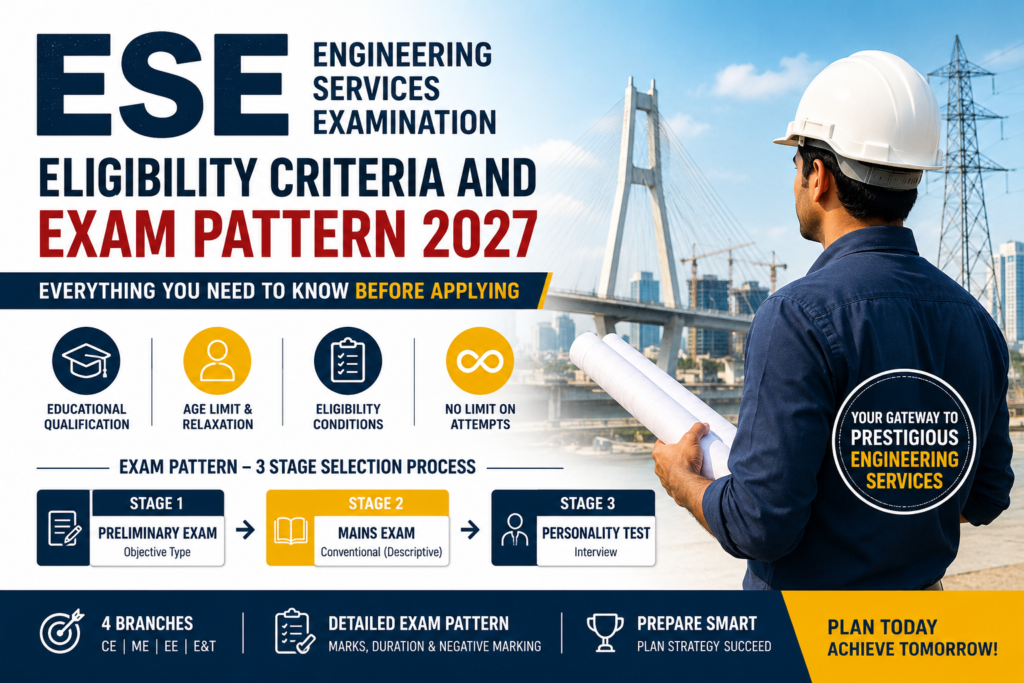
ESE Eligibility Criteria and Exam Pattern 2027 — Everything You Need to Know Before Applying
Before investing 12–18 months into ESE preparation, you need to confirm two things: that you are eligible to appear, and that you fully understand the exam’s structure. Many students begin preparation without verifying the branch restriction or age limit, only to discover mid-way that they do not qualify.
This article covers every eligibility condition for ESE 2027 and breaks down the exam pattern — stages, papers, marks, duration, and negative marking — in detail.
This is part of our Complete ESE / IES Guide for 2027. If you are new to the exam, start there.
Who Can Appear for ESE 2027 — Full Eligibility Conditions
1. Educational Qualification
Candidates must hold an engineering degree — B.E. or B.Tech — from a recognised university or equivalent institution. The degree must be in one of the four eligible disciplines:
- Civil Engineering
- Mechanical Engineering
- Electrical Engineering
- Electronics and Telecommunication Engineering
This branch restriction is the single most important eligibility condition for ESE. Students from Computer Science, Chemical Engineering, Aerospace, Biotechnology, Instrumentation, or any other discipline are not eligible — regardless of marks or merit.
Students in the final year of their engineering degree can appear for the Preliminary Examination. They must, however, submit documentary proof of completing the degree before the Mains examination. UPSC does not permit provisional appearances at the Mains stage.
2. Age Limit
Candidates must be between 21 and 30 years of age as on 1st January of the examination year.
| Category | Upper Age Limit |
|---|---|
| General / EWS | 30 years |
| OBC (Non-Creamy Layer) | 33 years (+3 years relaxation) |
| SC / ST | 35 years (+5 years relaxation) |
| PwBD (General / EWS) | 40 years (+10 years) |
| PwBD (OBC) | 43 years (+13 years) |
| PwBD (SC / ST) | 45 years (+15 years) |
| Defence Services personnel | 35 years (+5 years) |
3. Nationality
Candidates must be Indian citizens. The following foreign nationals are also eligible under specific conditions prescribed by the Government of India:
- Citizens of Nepal or Bhutan
- Tibetan refugees who came to India before 1st January 1962 with intent to permanently settle
- Persons of Indian origin who migrated from Pakistan, Myanmar, Sri Lanka, Kenya, Uganda, Tanzania, Zambia, Malawi, Ethiopia, Vietnam, or Zaire
4. Number of Attempts
UPSC does not impose any limit on the number of attempts for ESE. A candidate can appear as many times as they wish, provided they satisfy the age limit on each occasion. This is unlike civil services (UPSC IAS) which has attempt limits.
5. Physical Standards
Candidates must be physically fit as per standards prescribed by the Government of India. UPSC specifies minimum physical requirements for various services. Detailed medical standards are available in the official ESE 2027 notification.
ESE 2027 Exam Pattern — Stage by Stage
ESE is a three-stage selection process. Each stage is eliminatory — you must clear each stage to proceed to the next.
Stage 1 — Preliminary Examination (Objective)
The Prelims is an objective (multiple choice) exam held on a single day. It consists of two papers:
| Paper | Content | Total Marks | Questions | Duration |
|---|---|---|---|---|
| Paper I | General Studies and Engineering Aptitude | 200 | 100 | 2 hours |
| Paper II | Engineering Discipline (CE / ME / EE / E&T) | 300 | 150 | 3 hours |
Total Prelims marks: 500
Negative marking: 1/3 mark is deducted for each incorrect answer in both papers. Unattempted questions carry no penalty.
The Prelims score is used only for shortlisting candidates for Mains. It is not counted in the final merit list.
ESE Prelims 2027 scheduled date: 20th February 2027
Stage 2 — Mains Examination (Descriptive / Conventional)
Candidates shortlisted on the basis of Prelims performance appear for the Mains. The Mains consists of two conventional (descriptive) papers, both from the candidate’s engineering discipline:
| Paper | Content | Total Marks | Duration |
|---|---|---|---|
| Paper I | Engineering Discipline Part A | 300 | 3 hours |
| Paper II | Engineering Discipline Part B | 300 | 3 hours |
Total Mains marks: 600
The Mains is a written exam using pen and paper — not computer-based. Answers require diagrams, derivations, calculations, and structured written explanations. This is the key difference that separates ESE from GATE: Mains tests depth of understanding, presentation, and applied problem-solving — not just concept recognition.
No negative marking in the Mains.
ESE Mains 2027 scheduled date: 30th June 2027
Stage 3 — Personality Test (Interview)
Candidates who qualify at the Mains stage appear for a Personality Test conducted by a UPSC board. The interview carries 200 marks.
The Personality Test is not a technical quiz. The UPSC board evaluates:
- Clarity of thought and communication
- Awareness of current affairs and engineering developments
- Problem-solving approach and decision-making
- Leadership potential and service motivation
- General personality traits suited to a Class-I officer role
Final Merit and Selection
| Component | Marks | Counted in Merit? |
|---|---|---|
| Prelims | 500 | No — used only for Mains shortlisting |
| Mains Paper I | 300 | Yes |
| Mains Paper II | 300 | Yes |
| Personality Test | 200 | Yes |
| Total for Merit | 800 |
Final selection and rank are determined by the combined score of Mains (600) + Personality Test (200) = 800 marks. Service allocation — which department you are posted to — depends on your final rank and preference.
Important ESE 2027 Dates
| Event | Date |
|---|---|
| ESE 2027 Notification | September 2026 |
| Application window | September – October 2026 |
| Prelims Admit Card | First week of February 2027 |
| Prelims Examination | 20th February 2027 |
| Prelims Result | April / May 2027 (approximate) |
| Mains Examination | 30th June 2027 |
| Personality Test | October – December 2027 (approximate) |
How Many Students Appear and How Many Get Selected?
ESE is one of the most competitive engineering exams in India. Approximately 1.5 to 2 lakh candidates register for the Prelims each year across all four branches. The total number of posts available is around 167. The selection ratio at the final stage is roughly 1 in 700–1000 candidates who register.
This competition level is why structured preparation over 12–18 months is not optional — it is necessary.
Next Steps
Now that you understand the eligibility conditions and exam structure, the logical next step is to map the syllabus and build a preparation strategy. Read our next guide: ESE Syllabus 2027 and Preparation Strategy — Subject-by-Subject Breakdown.
If you are in Chennai and want structured ESE coaching, explore the IES GATE Training Academy ESE program or call us on +91 72990 77859.
Frequently Asked Questions
Can a Computer Science or Chemical Engineering student appear for ESE?
No. ESE is restricted to four branches only: Civil, Mechanical, Electrical, and Electronics & Telecommunication Engineering. Students from all other branches are ineligible. For non-eligible branches, GATE + M.Tech or GATE + PSU is the recommended path.
Does the Prelims score count in the final merit list?
No. The Prelims score is used exclusively to shortlist candidates for the Mains. The final merit and rank are calculated on Mains (600 marks) + Personality Test (200 marks) = 800 marks total.
Is there negative marking in ESE?
Yes, but only in the Prelims. A penalty of 1/3 mark applies for each incorrect answer in both Prelims papers. The Mains examination has no negative marking.
Can a student in the final year of B.Tech apply for ESE?
Yes. Final-year students can appear for the Preliminary Examination. They must produce their degree certificate before the Mains examination. Students who cannot provide the certificate at that stage are disqualified from the Mains.