
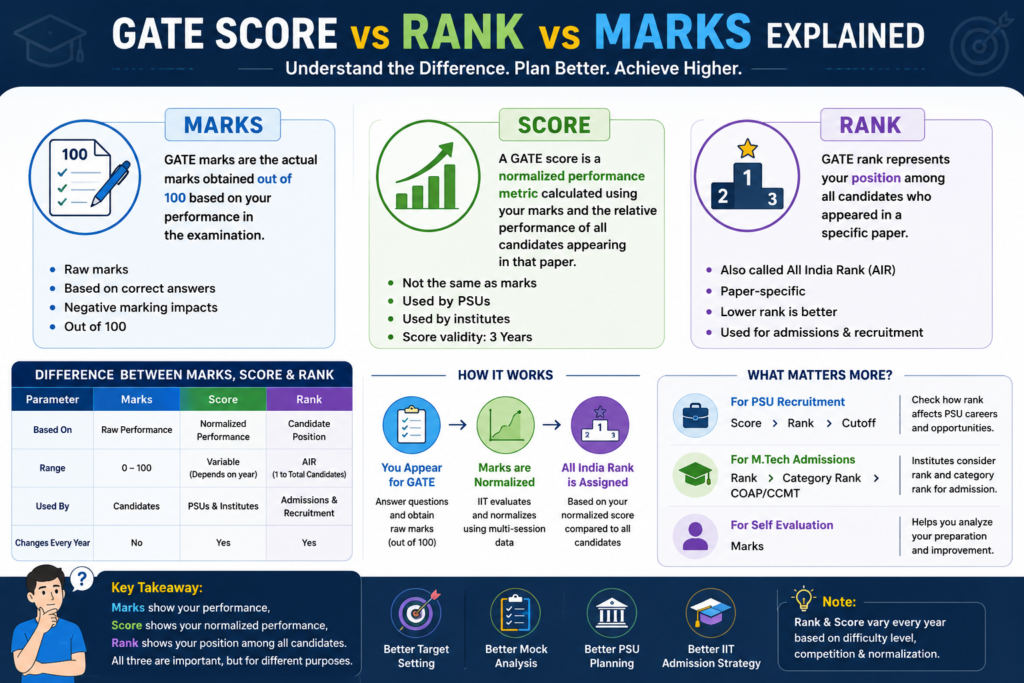
GATE Score vs Rank vs Marks Explained: What Really Matters?
One of the most common questions among GATE aspirants is surprisingly simple:
“I scored 55 marks in a mock test. Is that good?”
The answer depends on three different metrics: marks, score, and rank.
Many students use these terms interchangeably, but they represent completely different things in the GATE ecosystem. A candidate may have strong marks but an average rank, while another candidate may secure a higher GATE score because of normalization despite having similar marks.
Understanding the difference between GATE marks, score, and rank is critical if your goal is M.Tech admission at IITs and NITs, PSU recruitment, research opportunities, or simply evaluating your preparation progress accurately.
If you are new to GATE, start by understanding the GATE Eligibility Criteria and the GATE Exam Pattern and Marking Scheme before diving into score interpretation.
What Are GATE Marks?
Direct Answer: GATE marks are the actual raw marks you obtain out of 100 based on your performance in the examination after considering correct answers and applicable negative marking.
Marks are the most straightforward performance metric in GATE. Every correct answer contributes marks, while incorrect MCQs may result in negative marking.
Your marks are calculated directly from:
- Correct MCQ answers
- Correct MSQ answers
- Correct NAT answers
- Negative marking in MCQs
Since the examination carries 100 marks, your raw score always falls between 0 and 100.
Marks represent your actual performance in the exam. However, marks alone do not determine admission opportunities or PSU selection. That is where GATE score and rank become important.
What Is a GATE Score?
Direct Answer: A GATE score is a normalized performance metric calculated using your marks and the overall performance of candidates appearing in that paper.
The GATE score is not the same as your marks.
It is a standardized score calculated using methodologies defined by the organizing IIT and is designed to provide fair comparison across candidates.
GATE scores are widely used by:
- Public Sector Undertakings (PSUs)
- IIT admissions
- NIT admissions
- IIIT admissions
- Research institutions
- Government-funded fellowships
The official score calculation methodology is published each year in the official GATE information brochure.
A valid GATE score remains usable for admissions and recruitment opportunities for up to three years from the result date.
What Is GATE Rank?
Direct Answer: GATE rank represents your position among all candidates who appeared for a particular GATE paper.
Rank is often referred to as:
- All India Rank (AIR)
- Paper Rank
- Merit Position
Unlike marks, rank is relative. It depends not only on your performance but also on the performance of every other candidate appearing in the same paper.
In GATE, a lower rank is always better.
For example:
- AIR 50 is better than AIR 500
- AIR 500 is better than AIR 5000
Difference Between GATE Score, Rank and Marks
| Parameter | Marks | Score | Rank |
|---|---|---|---|
| Based On | Raw Performance | Normalized Performance | Candidate Position |
| Range | 0–100 | Variable | AIR |
| Used By | Candidates | PSUs & Institutes | Admissions & Recruitment |
| Changes Every Year | No | Yes | Yes |
How GATE Marks Are Calculated
Marks are calculated according to the official GATE marking scheme.
As explained in our detailed guide on GATE Exam Pattern and Marking Scheme, different question types contribute differently.
- MCQs may have negative marking
- MSQs have no negative marking
- NAT questions have no negative marking
Your final marks are the sum of all correct answers minus applicable penalties.
How GATE Score Is Calculated
Direct Answer: GATE score calculation uses normalization to account for differences in difficulty levels across sessions and papers.
For multi-session papers, candidates may receive different question sets.
To ensure fairness, the organizing IIT applies a normalization process.
The exact formula may vary slightly based on examination requirements, but the objective remains the same: ensuring candidates are evaluated fairly regardless of session variations.
This is why two candidates with similar marks may sometimes receive slightly different scores.
How GATE Rank Is Determined
Rank is determined by comparing candidates within the same paper.
Generally:
- Higher marks lead to higher scores
- Higher scores lead to better ranks
- Better ranks improve admission and PSU opportunities
However, rank depends on competition. A score that secures AIR 500 in one year may produce AIR 800 in another year due to changes in competition and paper difficulty.
Which Is More Important: Score, Rank or Marks?
For PSU Recruitment
PSUs typically focus on:
- GATE Score
- GATE Rank
- Category Cutoffs
Students targeting PSU careers should understand how rankings influence recruitment opportunities through our guide on GATE Rank and PSU Career Opportunities.
For M.Tech Admissions
IITs, NITs, and other institutes generally evaluate:
- Rank
- Category Rank
- COAP performance
- CCMT counseling position
Information regarding admissions can be verified through the Indian Institutes of Technology and participating admission portals.
For Self-Evaluation
Marks are often the best indicator when analyzing preparation progress because they show direct improvement in performance.
What Rank Can You Get for Different Marks?
Disclaimer: The following ranges are illustrative and vary significantly depending on the paper, competition level, and examination year.
| Marks Range | Approximate Rank Range |
|---|---|
| 80+ | Top 100 |
| 70–80 | Top 500 |
| 60–70 | Top 1,500 |
| 50–60 | Top 3,000 |
| 40–50 | Top 8,000 |
Actual outcomes vary considerably across disciplines such as Mechanical Engineering, Electrical Engineering, Civil Engineering, Computer Science, and Electronics.
Why Rank Changes Every Year
Many students assume identical marks always produce identical ranks.
That assumption is incorrect.
Rank changes because of:
- Paper difficulty level
- Number of candidates
- Competition intensity
- Normalization processes
- Overall performance distribution
A score considered exceptional in one year may become average in another year.
Why Two Students With Similar Marks May Have Different Scores
This is one of the most misunderstood aspects of GATE.
Two candidates with nearly identical marks may receive different GATE scores because normalization considers the relative performance of candidates across sessions.
This situation is more common in multi-session papers where examination conditions and question sets differ.
Understanding this distinction prevents students from making incorrect comparisons based solely on marks.
What Is a Good GATE Score?
A good GATE score depends entirely on your objective.
PSU Aspirants
Generally require highly competitive scores and ranks because PSU vacancies are limited.
IIT Aspirants
Need scores that comfortably exceed admission cutoffs for desired specializations.
NIT Aspirants
Often have broader opportunities depending on branch, institute, and category.
Working Professionals
May focus on obtaining a qualifying score that supports higher studies or career progression.
How Many Marks Are Needed for Top IITs?
There is no universal answer.
Admission requirements depend on:
- Branch
- Institute
- Competition level
- Category
- Available seats
Instead of targeting a specific mark, focus on maximizing rank. Future cutoff trends can be explored through a dedicated cutoff analysis article.
Common Misconceptions About GATE Scores
Myth: Score and Marks Are the Same
Reality: Marks represent raw performance, while score represents normalized performance.
Myth: 60 Marks Always Gives the Same Rank
Reality: Rank varies according to competition and paper difficulty.
Myth: Only Score Matters
Reality: Admissions and recruitment often consider rank, category position, eligibility, and institute-specific criteria.
Real Observation From IES GATE Training Academy
Based on analysis of hundreds of mock tests and previous GATE results at IES GATE Training Academy, one recurring pattern appears consistently.
Students often become obsessed with increasing attempted questions. However, significant rank improvements usually come from improving accuracy, reducing negative marking, strengthening weak concepts, and optimizing exam strategy.
In many cases, reducing just three or four incorrect MCQs can improve the final score enough to create meaningful rank movement.
How Understanding Score vs Rank Helps Your Preparation
- Sets realistic targets
- Improves mock test analysis
- Supports PSU planning
- Guides IIT admission strategy
- Helps prioritize accuracy over guesswork
- Improves performance forecasting
Students should also study the Complete GATE Syllabus Guide, explore the Best Books for GATE Preparation, and review Common GATE Preparation Mistakes to strengthen preparation outcomes.
FAQ
What is the difference between GATE score and marks?
Marks represent raw performance out of 100, while score is a normalized metric used for admissions and recruitment.
Is GATE score more important than marks?
For PSU recruitment and admissions, score and rank are often more important than raw marks.
What rank is considered good in GATE?
A good rank depends on your goals, but lower AIR values generally create better opportunities.
How much score is required for PSU jobs?
The required score varies by PSU, branch, vacancy count, and competition level.
Is 50 marks good in GATE?
In many papers, 50 marks is considered respectable and can lead to strong opportunities depending on the year.
Is 60 marks enough for IIT admission?
It may be sufficient for several programs, but admission depends on branch-specific cutoffs and competition.
How long is GATE score valid?
A GATE score remains valid for three years from the date of result announcement.
Can rank improve with the same marks?
No. Rank depends on relative performance and competition within a particular year.
Does normalization affect rank?
Yes. Normalization can influence final scores and consequently impact rankings.
What is a good AIR in GATE?
The answer depends on your objective, but ranks within the top few hundred generally provide strong opportunities.
Conclusion
Understanding the relationship between marks, score, and rank is essential for making informed decisions throughout your GATE journey.
Marks show your actual exam performance.
Score reflects normalized performance.
Rank reflects your position among competitors.
All three metrics matter, but their importance varies depending on whether your goal is PSU recruitment, M.Tech admission, research opportunities, or personal benchmarking.
After understanding score, rank, and marks, the next step is learning exactly what to study. Continue with our Complete GATE Syllabus Guide and Subject-Wise Weightage Analysis to build a preparation strategy that maximizes your score, improves your rank, and strengthens your chances of success.