
GATE Exam Pattern and Marking Scheme Explained (Latest Guide)
Every year, thousands of GATE aspirants spend months studying technical subjects, solving previous-year papers, and attending coaching classes. Yet many students lose valuable marks simply because they do not fully understand the GATE exam pattern and marking scheme.
Official GATE Information Brochure
A strong preparation strategy begins with understanding how the examination is structured, how questions are evaluated, where negative marking applies, and how different question types affect scoring.
Based on the analysis of hundreds of mock test attempts at IES GATE Training Academy, one recurring observation is that many students lose 5–10 marks not because of weak concepts but due to poor question selection, incorrect time management, and unnecessary negative marking. In a competitive exam where a few marks can significantly impact rank, understanding the exam pattern becomes as important as subject preparation itself.
If you are new to GATE, start by checking the GATE Eligibility Criteria before planning your preparation journey.
What Is the GATE Exam Pattern?
The GATE exam pattern defines the structure of the examination, including the number of questions, total marks, duration, sections, question types, and marking scheme.
GATE is conducted as a Computer-Based Test (CBT) and follows a standardized format across all papers. While the syllabus differs from one discipline to another, the overall examination structure remains largely the same.
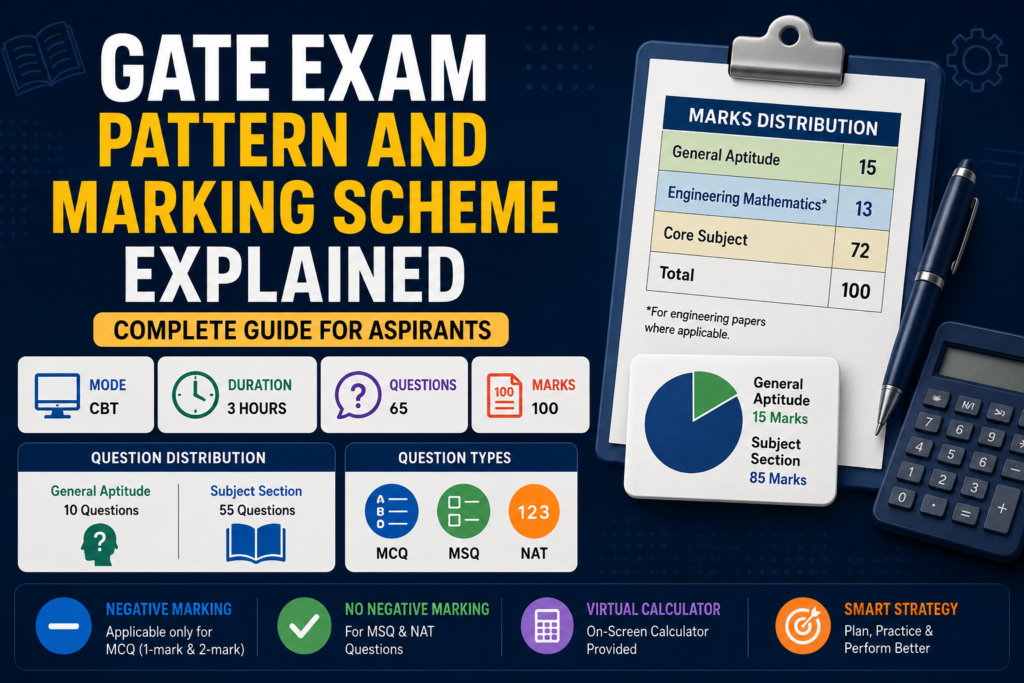
- Mode: Computer-Based Test (CBT)
- Duration: 3 Hours
- Total Questions: 65
- Total Marks: 100
- Medium: English
- Question Types: MCQ, MSQ, NAT
- Sections: General Aptitude and Subject Section
GATE 2026 Exam Pattern Overview
| Particulars | Details |
|---|---|
| Mode | Computer-Based Test (CBT) |
| Duration | 3 Hours |
| Total Questions | 65 |
| Total Marks | 100 |
| Medium | English |
| Sections | General Aptitude + Subject Section |
| Question Types | MCQ, MSQ, NAT |
| Calculator | Virtual Calculator Only |
GATE Marks Distribution
Every GATE paper carries a total of 100 marks.
| Component | Marks |
|---|---|
| General Aptitude | 15 |
| Subject Questions (Core + Engineering Mathematics) | 85 |
| Total | 100 |
For most engineering papers, Engineering Mathematics contributes approximately 13 marks, while the remaining marks come from the core technical subjects of the chosen branch.
How Many Questions Are Asked in GATE?
One of the most common questions students ask is: “How many questions are there in GATE?”
| Section | Questions |
|---|---|
| General Aptitude | 10 |
| Subject Section | 55 |
| Total | 65 |
The exact mix of question types may vary depending on the paper, but the overall question count remains consistent.
Distribution of 1-Mark and 2-Mark Questions
GATE consists of both 1-mark and 2-mark questions.
- 1-Mark Questions
- 2-Mark Questions
Together, these 65 questions carry a total of 100 marks. The exact distribution may vary slightly across different GATE papers and examination years.
This structure ensures that candidates are tested on both fundamental concepts and advanced problem-solving abilities.
Sections in the GATE Exam
General Aptitude (15 Marks)
The General Aptitude section evaluates verbal ability and numerical ability. It is common across all GATE papers and contributes 15 marks.
Because aptitude questions are generally less technical, many high-ranking candidates consider this section a scoring opportunity.
Engineering Mathematics
Engineering Mathematics is included in most engineering papers and usually contributes around 13 marks. Topics commonly include linear algebra, calculus, probability, differential equations, and numerical methods.
Core Subject
The largest portion of the paper comes from the candidate’s chosen discipline, such as Mechanical Engineering, Civil Engineering, Electrical Engineering, Electronics, Computer Science, and others.
For detailed coverage, refer to our Complete GATE Syllabus Guide.
GATE Question Types Explained
Multiple Choice Questions (MCQ)
MCQs contain four answer options with only one correct answer. These questions carry negative marking for incorrect responses.
Multiple Select Questions (MSQ)
MSQs may have more than one correct answer. Candidates must select all correct options to receive marks.
MSQs do not carry negative marking.
Numerical Answer Type (NAT)
NAT questions require candidates to enter a numerical value using the keyboard. No answer options are provided.
NAT questions do not carry negative marking.
Difference Between MCQ, MSQ and NAT
| Feature | MCQ | MSQ | NAT |
|---|---|---|---|
| Single Answer | Yes | No | Numeric |
| Negative Marking | Yes | No | No |
| Calculator Needed | Sometimes | Rarely | Often |
GATE Marking Scheme Explained
The marking scheme determines how marks are awarded and deducted during the examination.
| Question Type | Correct Answer | Wrong Answer | Unanswered |
|---|---|---|---|
| 1-Mark MCQ | +1 | -1/3 | 0 |
| 2-Mark MCQ | +2 | -2/3 | 0 |
| MSQ | Full Marks | 0 | 0 |
| NAT | Full Marks | 0 | 0 |
Which Questions Have No Negative Marking in GATE?
This is one of the most searched GATE questions.
Negative marking is NOT applicable for:
- MSQ (Multiple Select Questions)
- NAT (Numerical Answer Type Questions)
Only MCQs attract negative marking for incorrect answers.
This is why experienced candidates often attempt NAT and MSQ questions more aggressively than doubtful MCQs.
How Negative Marking Impacts GATE Rank
Even a loss of 3–5 marks due to incorrect MCQs can significantly affect rank.
At higher score ranges, rank differences are often determined by only a few marks. Candidates who avoid unnecessary guesses typically achieve better ranks than equally knowledgeable candidates who attempt doubtful questions aggressively.
This is one reason why mock test analysis is critical during preparation.
Smart Attempt Strategy for GATE
- Solve easy NAT questions first.
- Attempt familiar MCQs with high confidence.
- Move to MSQs carefully.
- Avoid random guessing in MCQs.
- Review flagged questions before submission.
Students who follow a structured attempt strategy generally achieve better accuracy and lower negative marking.
Does the Exam Pattern Differ Across GATE Papers?
The overall structure remains the same across GATE papers.
- 65 Questions
- 100 Marks
- 3 Hours Duration
- MCQ, MSQ and NAT Questions
What changes is the syllabus and technical content specific to the chosen paper.
How to Use the GATE Virtual Calculator
GATE provides an on-screen virtual calculator for calculations during the examination.
Physical calculators, scientific calculators, programmable calculators, and mobile phones are not permitted inside the examination hall.
Students should practice using the virtual calculator before the exam because unfamiliarity can increase solving time during numerical questions.
Common Mistakes Students Make Regarding the Exam Pattern
- Ignoring MSQ questions
- Randomly guessing MCQs
- Poor time allocation across sections
- Not practicing NAT questions
- Avoiding full-length mock tests
- Not understanding negative marking rules
Many of these mistakes are discussed in detail in our guide on Common GATE Preparation Mistakes.
GATE Exam Pattern vs Preparation Strategy
| Pattern Element | Preparation Strategy |
|---|---|
| MCQs | Focus on accuracy |
| NATs | Improve calculation speed |
| MSQs | Strengthen conceptual understanding |
| General Aptitude | Daily practice |
Has the GATE Exam Pattern Changed Over the Years?
The overall structure of the GATE examination has remained largely consistent in recent years.
- 65 Questions
- 100 Marks
- 3 Hours Duration
- MCQ, MSQ and NAT Question Types
Minor changes may occur through official notifications, so candidates should always review the latest information brochure before appearing.
How Understanding the Exam Pattern Improves Rank
Understanding the exam pattern helps candidates:
- Reduce negative marking
- Improve accuracy
- Manage time effectively
- Maximize score potential
- Achieve better ranks
A higher score can directly improve opportunities for M.Tech admissions and PSU recruitment. Learn more in our guide on How GATE Rank Influences PSU Career Opportunities.
Official Source for GATE Exam Pattern
Candidates should always refer to the latest GATE Information Brochure released by the organizing IIT for the most accurate and updated exam pattern, eligibility rules, and marking scheme details.
If you have not yet checked your eligibility, read our detailed GATE Eligibility Criteria Guide.
Quick Exam Pattern Checklist
- ✔ Understand all question types
- ✔ Know where negative marking applies
- ✔ Practice the virtual calculator
- ✔ Attempt regular mock tests
- ✔ Develop a time-management strategy
- ✔ Learn section-wise weightage
- ✔ Analyze mistakes after every test
Frequently Asked Questions (FAQs)
What is the GATE exam pattern?
GATE is a 3-hour computer-based test consisting of 65 questions carrying 100 marks.
How many questions are there in GATE?
There are 65 questions in every GATE paper.
How many marks is General Aptitude in GATE?
General Aptitude carries 15 marks.
How many marks are allotted to the core subject?
The subject section carries 85 marks, including Engineering Mathematics where applicable.
Is there negative marking in GATE?
Yes. Negative marking applies only to MCQs.
Which questions have no negative marking?
MSQ and NAT questions do not carry negative marking.
Can I leave questions unanswered?
Yes. Unanswered questions receive zero marks and no penalty.
Is there sectional timing in GATE?
No. Candidates can move freely between sections during the 3-hour examination.
Can I revisit questions during the exam?
Yes. Questions can be marked for review and revisited before submission.
Can I use a scientific calculator in GATE?
No. Only the official on-screen virtual calculator is allowed.
Conclusion
Understanding the GATE exam pattern and marking scheme is one of the easiest ways to improve performance before beginning serious preparation. Candidates who understand question types, marks distribution, negative marking rules, and attempt strategy often gain a significant advantage over equally prepared competitors.
Your next step should be understanding the complete syllabus and topic weightage for your branch. Continue with our Complete GATE Syllabus Guide, explore the GATE Subject-Wise Weightage Analysis, review the Best Books for GATE Preparation, and build a structured study plan using our How to Start GATE Preparation guide.